Quick answer
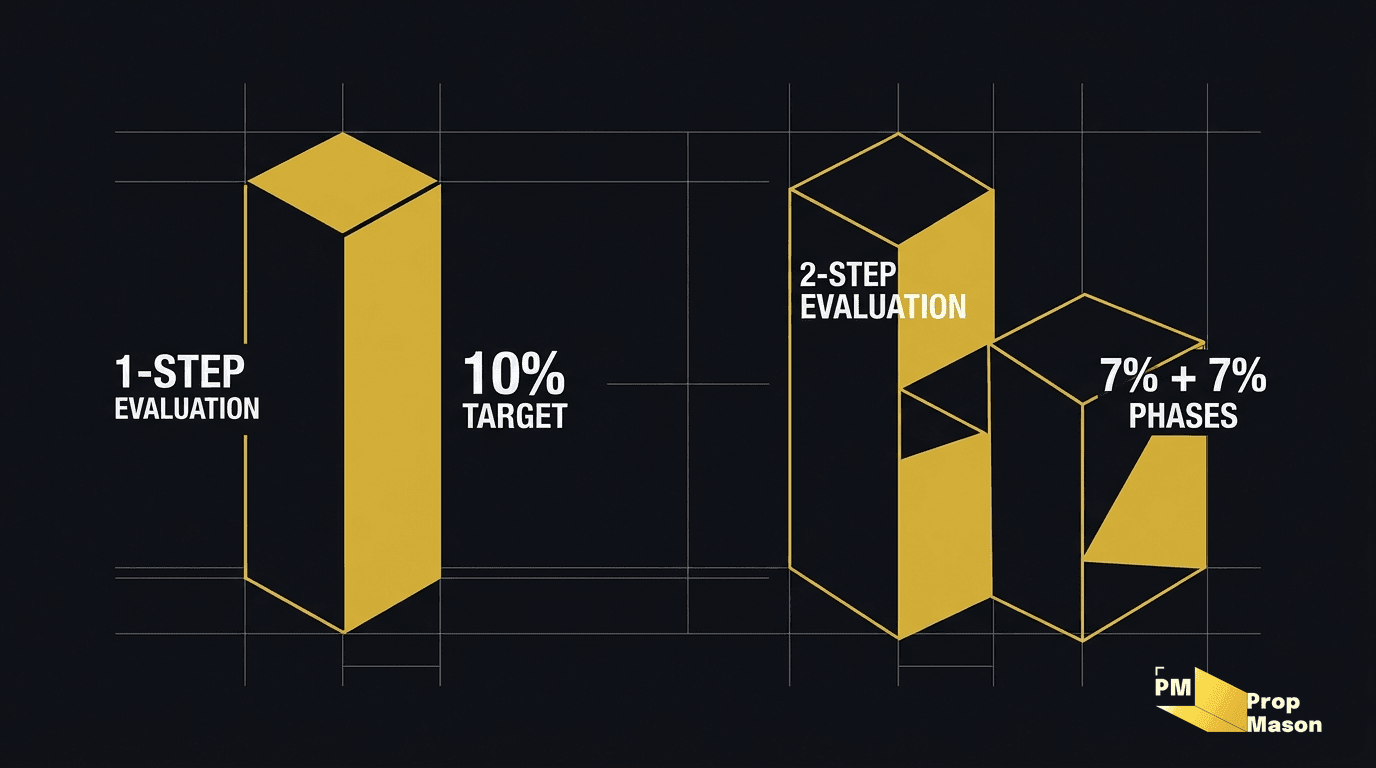
One-step and two-step describe evaluation path length, not outcome quality. A one-step path may concentrate its target and rules in one phase. A two-step path may distribute targets across two phases, but the target, drawdown, minimum-day, fee and transition rules vary by program.
Keep four milestones separate: completing evaluation, activating the funded or simulated funded stage, passing KYC and becoming eligible for a first payout. Fewer formal phases do not prove that all four milestones happen sooner.
Rule Burden v1.0
PropMason compares each model across five groups:
- Evaluation path: formal phases, target per phase, minimum and maximum days, carryover and reset behavior.
- Risk limits: daily loss, maximum loss, static or trailing method, consistency and prohibited strategies.
- Cost: regular fee, active promotion, recurring charge, activation, reset, refund and currency.
- Transition: funded-account state, KYC, payout minimum, first-payout timing and payout cycle.
- Restrictions: markets, platform, news, overnight/weekend holding, location and account-stage limits.
Treat an absent field as not confirmed, not as zero. A conceptual pattern is not a program fact.
Normalized 50K evidence snapshot
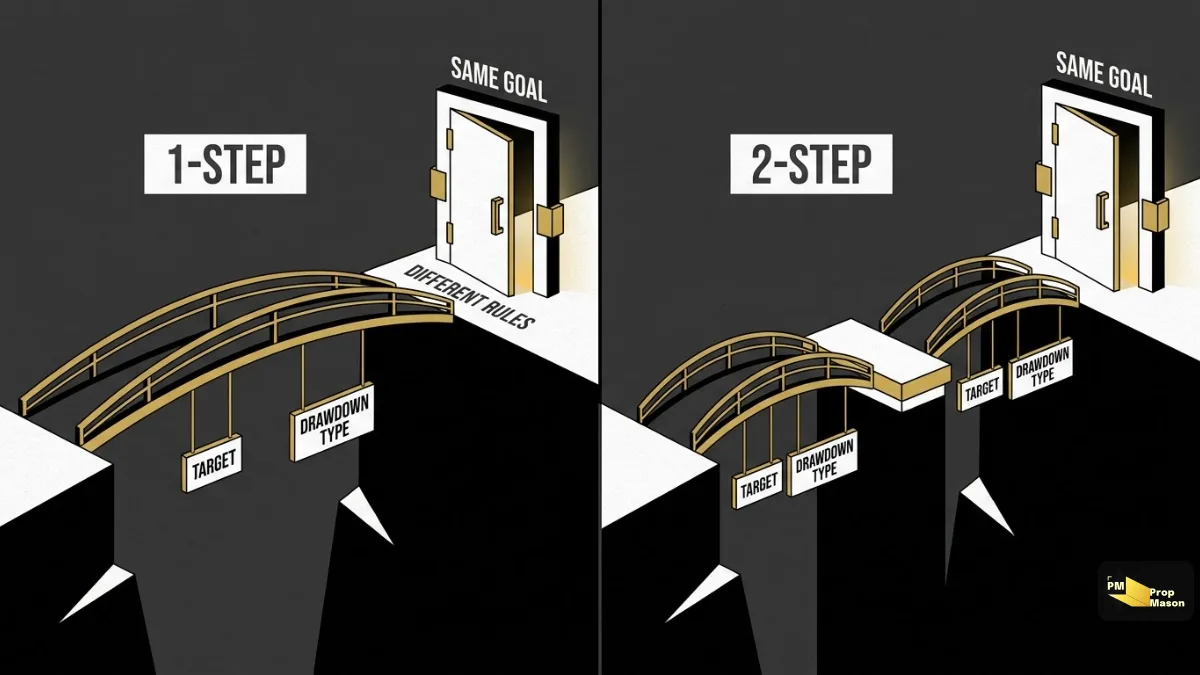
The following rows use the same account size and currency from Funded Trading Plus selector evidence checked 2026-09-28. PropMason's published score for Funded Trading Plus is currently capped while review findings are checked; the live score is on its firm page.
| Field | 1-Step Express | 2-Step Classic |
|---|---|---|
| Evaluation phases | 1 | 2 |
| Target | 10% / $5,000 | 7% + 7% / $3,500 + $3,500 |
| Regular fee | not confirmed yet; check the firm's own pricing page | not confirmed yet; check the firm's own pricing page |
| Captured active promotion | not confirmed yet; check the firm's own pricing page | not confirmed yet; check the firm's own pricing page |
| Daily drawdown | 4% (balance-based) / $2,000 | 4% (balance-based) / $2,000 |
| Maximum drawdown | 6% trailing / $3,000 | 8% static / $4,000 |
| Consistency score | None | 35% (Challenge) / 50% (Funded) |
| Symbol loss limit | None | 3% |
| Reward split | 80% | 80% |
| Payout evidence | From day 0, then every 7 days | Every 10 days |
On these rows the 1-Step's maximum loss trails upward as the account grows while the 2-Step's maximum loss is a static floor that never moves; the 2-Step also adds a consistency score and a symbol loss limit that the 1-Step does not have. Both rows carry the same 4% balance-based daily loss here.
This is a dated row comparison, not a cheapest, easiest or safest ranking. The promotion may expire. Current checkout, rulebook, phase carryover, refund and payout terms must be refreshed before payment.
How to interpret the snapshot
For the captured 50K rows, the one-step target is concentrated in one phase, while the two-step target is split into two 7% phases. That describes the recorded programs; it does not predict the time a trader needs.
The rows also show why phase count alone is incomplete. The one-step row has a captured trailing maximum-loss model, while the two-step row has a captured static maximum-loss model. Daily loss is the same in the snapshot, but the maximum-loss reference differs.
The regular and active prices are separate fields. A promotion is temporary: not a permanent discount and not evidence that either model has lower total cost after resets, subscriptions or other charges.
Turn the snapshot into a conditional choice
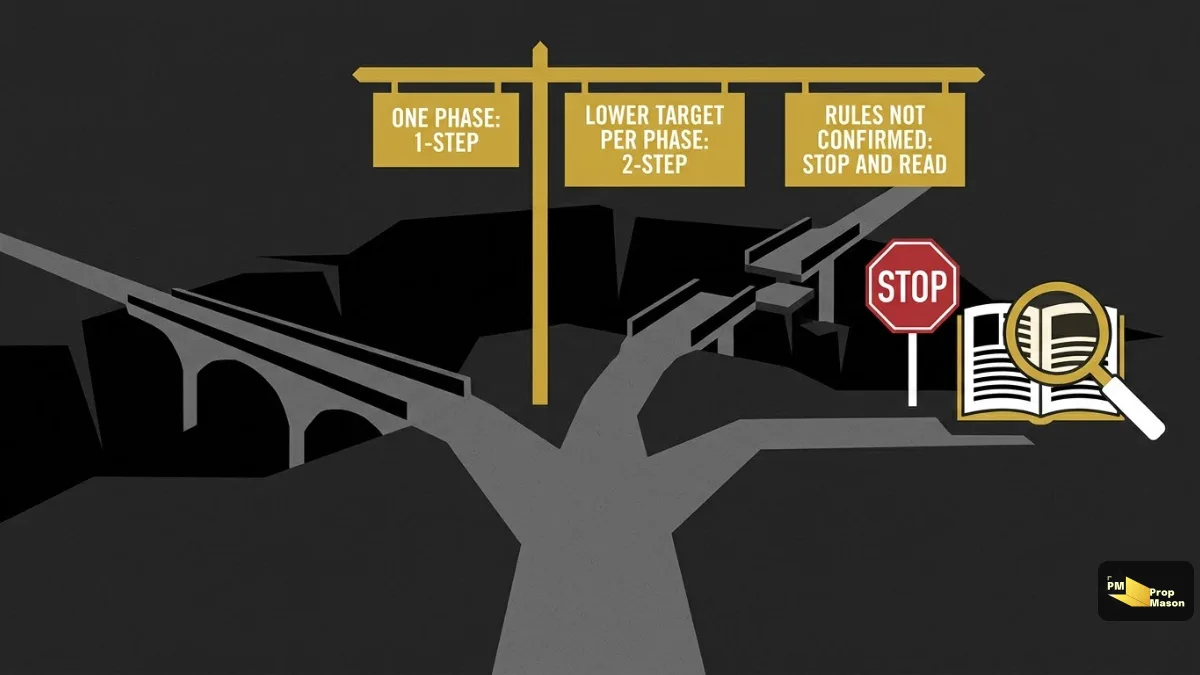
The captured rows support a next-check recommendation, not a universal winner. Use the constraint that matters most, then verify the exact current program before paying.
| If this is your constraint | Captured signal | Next check |
|---|---|---|
| One formal evaluation is non-negotiable | The 1-Step row has one phase and a concentrated 10% target. | Confirm that target, the captured trailing maximum-loss model, minimum days and post-pass transition fit the exact rulebook. |
| You prefer a lower target per phase | The 2-Step row splits the captured target into 7% + 7% across two phases. | Confirm phase-two carryover, total time exposure, restrictions and first-payout conditions. |
| Captured entry fee is your first filter | Current fees are not confirmed on either row. | Compare them at checkout, including resets and activation before calling total cost lower. |
| Drawdown mechanics drive the choice | The snapshot records trailing maximum loss for 1-Step and static maximum loss for 2-Step. | Check which reference your strategy can tolerate; phase count is secondary to the exact loss rule. |
Use these outputs:
- Continue checking 1-Step: only when the concentrated target and exact loss/transition rules are compatible with your plan.
- Continue checking 2-Step: only when the second-phase rules and additional phase exposure are clear and acceptable.
- Stop the comparison: if a material drawdown, carryover, cost or payout field is missing or stale. Keep it not confirmed yet; check the firm's own page instead of choosing by phase count.
Verification questions
Answer these six questions for the exact program before you pay; if you cannot answer one, the comparison is not finished.
- Can you explain the target, minimum days and breach rule for every phase?
- Does the loss limit use balance, equity, static or trailing reference?
- Does phase two start with a new target or carry a previous balance/risk state?
- Are news, overnight, weekend and prohibited-strategy rules identical across stages?
- What happens between evaluation completion, activation, KYC and first payout?
- Are reset, refund, activation and recurring charges included in the scenario cost?
These questions test compatibility; they do not provide personalized financial advice.
Related Reading
- Instant funding vs challenge.
- Prop firm fees comparison.
- Trailing vs EOD vs static drawdown.
- Challenge reset policies.
- Prop firm payout rules.
- Prop firm drawdown rules.
- How to Pass a Prop Firm Challenge.
- Affiliate policy.
Sources and Methodology
PropMason rates firms with its published scoring model.
- Funded Trading Plus 1-Step Express supplied the one-step program and 50K row.
- Funded Trading Plus 2-Step Classic supplied the two-step program and 50K row.
- The selector contract recorded account size, regular price, active price, targets, daily drawdown, maximum drawdown, drawdown type, reward split and evaluation steps.
- Observation date: checked 2026-09-28. Confidence: medium-high for the captured official-site state.
- Refresh rule: re-open the exact program page and checkout before deciding or paying; preserve regular, active, coupon and unknown fields separately.
- If the information changes: record the program, account size, currency, stage, source URL, retrieval date and changed field, then correct or remove the row.
Trading futures and forex carries a risk of loss. The CFTC and the NFA publish warnings and fraud advice for traders in the United States.
Read how PropMason checks and edits its pages in the editorial policy.
FAQ
Is a one-step challenge easier than a two-step challenge?
Not automatically. One-step concentrates the captured target in one phase, while two-step splits the captured target across two phases. Drawdown, minimum days, restrictions and transition rules can change the practical burden.
Is a two-step challenge cheaper?
The current fees are not confirmed; compare them at checkout, including resets and activation. A single snapshot does not establish total cost across firms, currencies, resets, subscriptions or refunds.
Does two-step carry the first phase into the second?
Unknown unless the exact program states it. Check whether targets, balance, drawdown, minimum days and restrictions reset or carry at the phase transition.
Does fewer evaluation phases mean faster payout?
No. Evaluation completion, activation, KYC and first-payout eligibility are separate milestones. Verify each one in the current program terms.
What should be compared before choosing a model?
Compare the exact target and phase rules, loss model, total scenario cost, restrictions, funded transition, KYC, payout terms and source date. If a critical field is missing, keep it not confirmed yet; check the firm's own page.
What is the difference between FTMO's 1-Step and 2-Step challenge?
On PropMason's FTMO page the two-step Challenge asks for a 10% target and then 5%, with a 5% daily loss limit, a 10% maximum loss and an 80% split. The one-step account uses a single 10% target, a 3% daily loss limit and a 90% split.
Which prop firms offer a one-step challenge?
On PropMason's pages FTMO (1-Step), Funded Trading Plus (1-Step Express), Take Profit Trader (one-step Trading Test) and Topstep (Trading Combine) list one-step programs. Rules differ by firm, so compare the exact program.
Next step
Write down one same-size one-step row and one same-size two-step row from current official pages. Do not decide from phase count alone; when evaluating a one step vs two step prop firm challenge, refresh fees, rules, restrictions and payout eligibility immediately before payment.