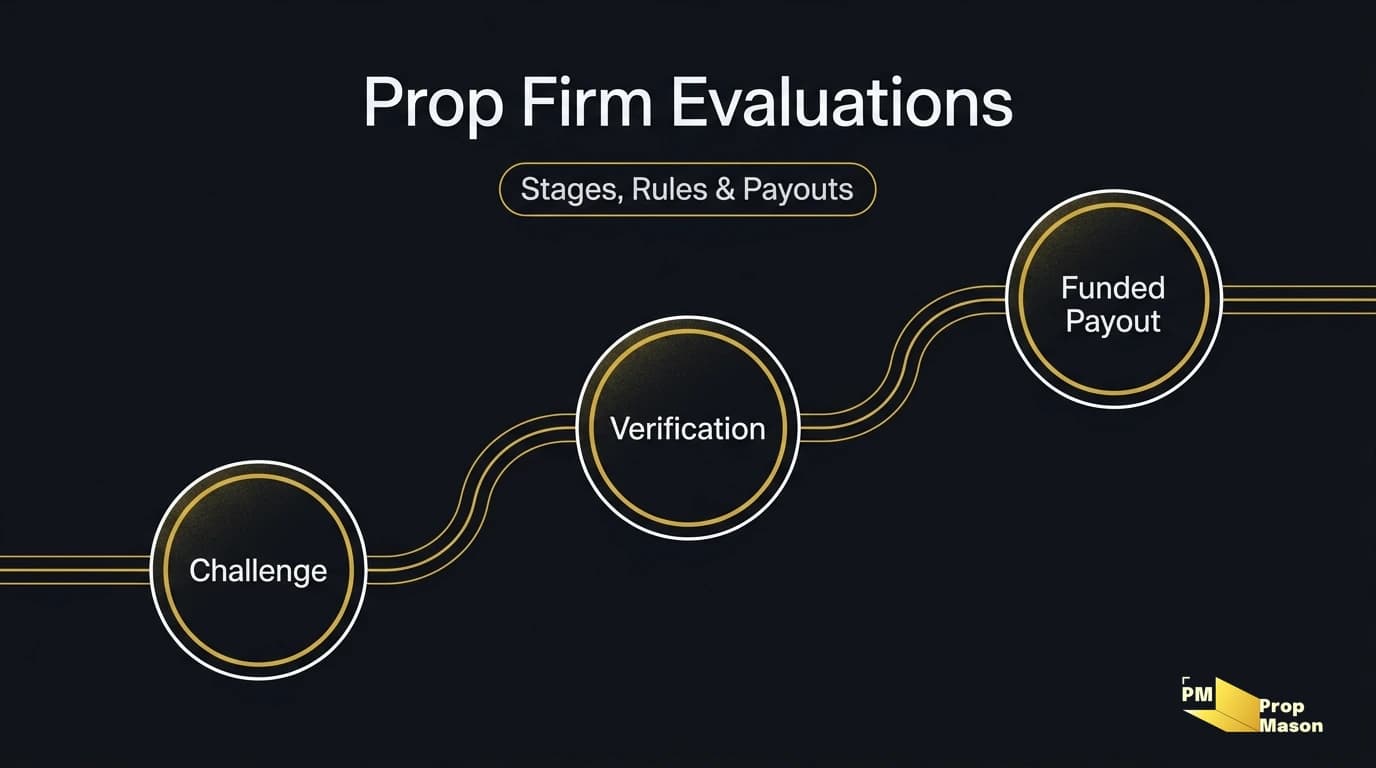
Quick answer
There is no single industry evaluation flow. A useful field model is: purchase or registration, evaluation, any second or verification phase, account activation, KYC or compliance review, first-payout eligibility and request, then provider processing and receipt.
One-step and two-step describe formal evaluation phases only. They do not prove that one route is easier, safer, cheaper or faster to payout. A product marketed without an evaluation also does not, by that label alone, prove that the trader receives live firm capital from day one.
An illustrative evaluation field model
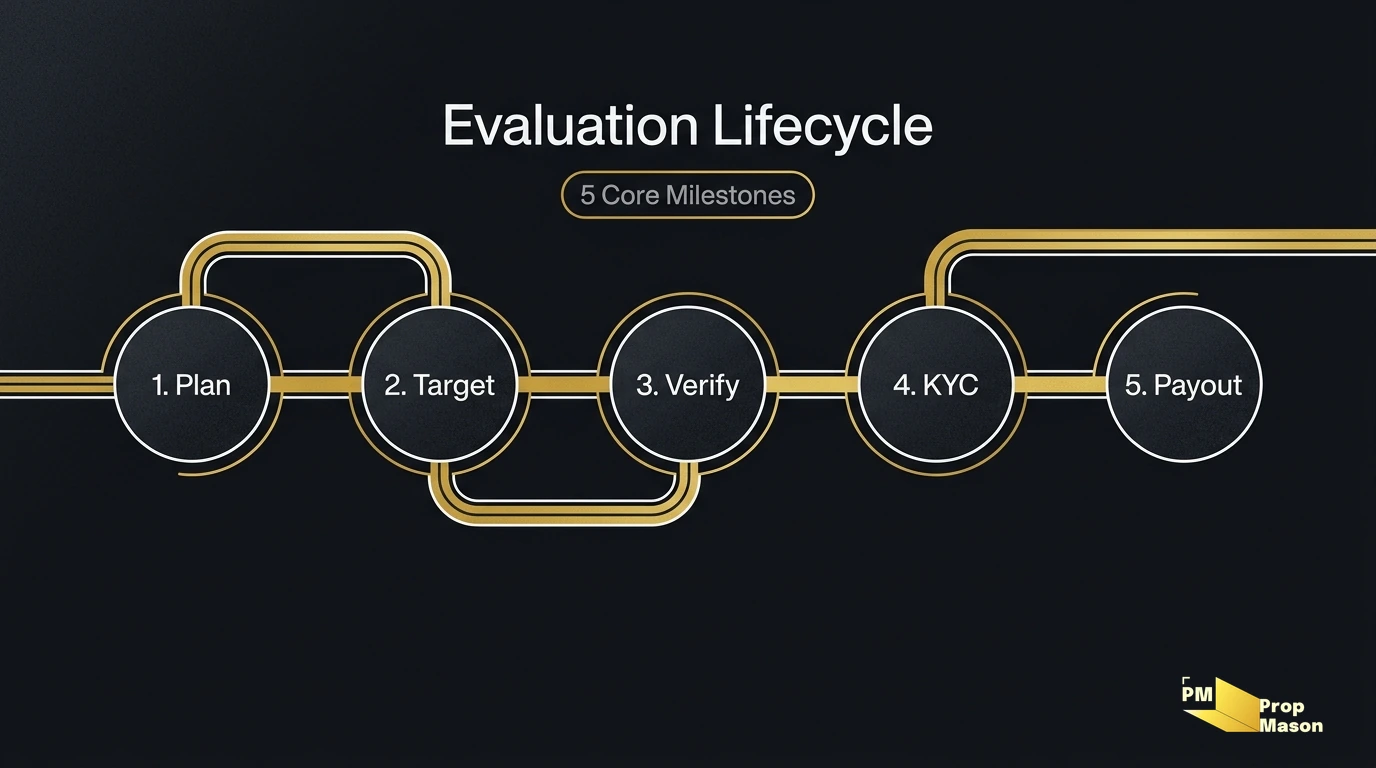
- 1. Purchase or registration: record the exact product, account size, currency, fee state, platform and country eligibility.
- 2. Evaluation phase: record the target, daily-loss and maximum-loss rules, drawdown reference, minimum or maximum time, consistency conditions and prohibited behavior.
- 3. Second or verification phase, if present: check which targets, balances, limits and restrictions reset or carry forward.
- 4. Account activation or status change: identify whether the next account is described as funded, simulated funded, virtual or another official term.
- 5. KYC or compliance review: treat identity approval as its own milestone; required documents and timing vary by provider.
- 6. First-payout eligibility and request: verify waiting periods, minimums, profit split, rule review and request procedure.
- 7. Processing and receipt: a submitted or approved request is not the same as funds received through the payout provider.
This is an evidence-recording model, not a claim that every firm uses seven formal stages. A program can combine, rename or omit milestones, so the official terms control.
Program labels and scoped official examples
- One-step: one formal evaluation phase in the named program. Target, loss model, time rules and post-pass transition still need separate fields.
- Two-step: two sequential evaluation phases. The source must state what changes or carries into phase two.
- No-evaluation or instant label: no formal challenge may be advertised, but account model, drawdown, activation, KYC and payout conditions still require official confirmation.
Funded Trading Plus pages checked 2026-09-28 provide a same-size example: its displayed 50K 1-Step Express row had one 10% target, while its displayed 50K 2-Step Classic row had two 7% targets. The rows also used different maximum-loss models. They show program variation; they do not establish an industry norm or an easier route.
Topstep's Trading Combine parameters page, checked 6 October 2026, publishes one rule (the Maximum Loss Limit), two objectives (the profit target and a consistency target) and a trading day that ends at 3:10 PM CT. FTMO's Trading Objectives page, checked 2026-09-28, publishes stage-specific loss objectives for FTMO 1-Step. Earn2Trade describes the Gauntlet Mini as a virtual evaluation and displays subscription and risk fields (checked 2026-09-28). Each example is limited to the named program and observation date.
What to verify before paying
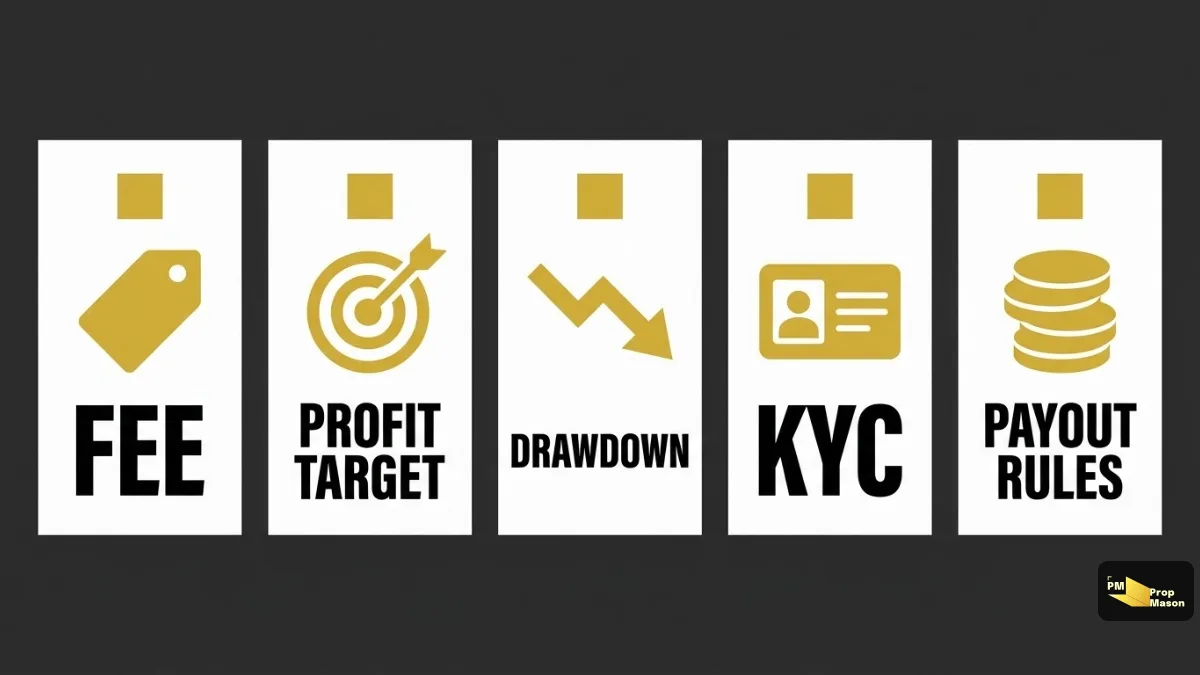
Record these fields from the exact official program and stage:
- product name, account model, size, currency, platform and eligible location;
- regular fee, active promotion, subscription, reset, activation, refund and tax or FX fields;
- target, daily loss, maximum loss, drawdown reference, update timing and breach wording;
- minimum or maximum days, consistency conditions and prohibited behavior;
- phase-transition rules and whether balances, targets or limits reset or carry;
- account status after passing, KYC trigger and provider-specific requirements;
- first-payout eligibility, minimum, profit split, request process, processing provider and receipt state;
- the page link and the date you read it.
If a material field is absent, conflicting or stale, keep it unverified; check directly. Do not fill it from a coupon, forum post or a different product from the same firm.
Use the flow as a decision gate
First locate your current milestone:
- Before paying: read the exact product page, rulebook and fee, refund and reset terms.
- Between phases: verify the transition rules and which targets, balances or limits reset or carry forward.
- After passing: confirm the account status, activation step, KYC trigger and first-payout conditions.
- After requesting a payout: separate provider processing from the point when funds are actually received.
Then choose one output:
| Output | Use it when | Next action |
|---|---|---|
| Ready for a final fit check | The current official sources resolve every breach-affecting field, cost state, account model, KYC milestone and payout milestone. | Compare those conditions with your own plan; do not rely on the headline fee or phase count alone. |
| Keep comparing | The fields are known, but phase burden, loss model, time or subscription exposure create trade-offs you have not normalized. | Put the same fields side by side and record the date and program scope for each row. |
| Do not pay yet | A material field is missing, conflicting or stale. | Ask for clarification, save the dated response, and keep the field unknown until the official terms resolve it. |
Worked application: the dated Funded Trading Plus 50K rows above show one displayed 10% target for 1-Step Express and two displayed 7% targets for 2-Step Classic. That is not enough to select a winner because the maximum-loss models differ. The evidence-supported output is keep comparing: refresh the current terms, record each loss formula and check what carries into the next phase. If a material rule remains unclear, use do not pay yet.
Common mistakes
Collapsing milestones: evaluation completion, activation, KYC, payout eligibility, request approval and receipt are different events.
Comparing only phase count or fee: one-step versus two-step is incomplete without target burden, loss model, restrictions, transition rules and total scenario cost.
Treating marketing labels as account facts: "funded" or "instant" does not by itself establish live capital, live execution or make payout certain.
Generalizing one rulebook: a consistency rule, restricted strategy, change-notice clause or KYC bundle from one program cannot be applied to the industry.
Using reviews as rule evidence: community reports can suggest verification questions, but they do not replace the firm's current rulebook.
Ignoring position sizing: size positions so a single trade cannot end the evaluation. Set risk per trade so an ordinary losing streak cannot reach the daily loss limit, and keep a personal daily stop below the firm's threshold.
Related Reading
- One-step vs two-step challenges
- Prop firm fees comparison
- Prop firm drawdown rules
- Trailing drawdown rules
- Payout terms by firm
- Consistency rules by firm
Sources and methodology
PropMason rates firms with its published scoring model.
- Funded Trading Plus 1-Step Express and 2-Step Classic: 50K program pages, checked 28 September 2026. Check the current checkout before buying.
- Funded Trading Plus KYC process: the page shows a last update of 07.02.2026 and was checked 6 October 2026. It supports the FTP process only, not a universal document list.
- Topstep Trading Combine parameters: checked 2026-09-28; scope limited to the Trading Combine.
- FTMO Trading Objectives: checked 2026-09-28; scope limited to the displayed FTMO 1-Step objectives used here.
- Earn2Trade Gauntlet Mini: checked 2026-09-28; scope limited to displayed virtual-evaluation, subscription and risk fields.
Compare the exact program and stage, keep regular and promotional prices separate, and leave missing transition or payout fields unverified.
PropMason may receive a commission through links; see the affiliate policy. This content is educational, not financial, legal, tax or investment advice.
Trading futures and forex carries a risk of loss. In the United States, the CFTC and the NFA publish fraud warnings and guidance for traders.
Read how PropMason checks and edits its pages in the editorial policy.
FAQ
What is a prop firm evaluation?
It is a program-specific rule stage in which a trader attempts stated objectives without breaching the applicable limits. The program may use a simulated or virtual account, and completion is separate from account activation, KYC and payout.
How does a one-step evaluation differ from a two-step evaluation?
One-step has one formal evaluation phase; two-step has two sequential phases. That label does not show total target burden, drawdown, time, cost or payout transition, so compare those fields in the exact program.
Does passing an evaluation guarantee a funded account or payout?
No. Passing can be followed by verification, activation, account-status conditions, KYC, ongoing rule checks and first-payout eligibility. A payout request, provider approval and receipt are also separate events.
When does KYC happen?
There is no universal point. Funded Trading Plus, for example, documents KYC for its own simulated-live account or withdrawal process. Other providers may use a different trigger, vendor, document set or review time.
How long does a prop firm evaluation take?
No universal duration is supported. Check the exact program's minimum or maximum days, objective rules, phase transitions and account-activation conditions. Do not infer payout timing from evaluation duration alone.
What is the easiest prop firm to pass?
There is no universally easiest prop firm to pass. Evaluation difficulty depends on target size, drawdown type, time limits and trading restrictions relative to your specific strategy. A program that seems easy for one trader may breach another trader's risk parameters. Always compare the exact rules of each firm.
What is the average prop firm pass rate?
No official industry pass rate is published. If a firm publishes its own figure, read it on the firm's page and note the date.
Next step
Before paying, create one dated record for the exact product: evaluation phases, loss rules, cost state, account model, KYC trigger and payout milestones. Knowing each rule before you start is the first step in learning how to pass a prop firm challenge.
Start with What Is a Prop Firm? Beginner Checklist if you are new.