Learn how PropMason orders firms or browse the full prop firm directory.
Each row is one 50K evaluation as the firm's own website showed it on 13 October 2026. The table shows each firm's list price. Sales lower the checkout rate.
| Program | Entry fee | How it is billed | Reset fee | Max loss limit | Charged after you pass |
|---|---|---|---|---|---|
| TradeDay Quick Pay Intraday | $131 | monthly | $59 | $2,000 | $0 |
| TradeDay Fast Pass End of Day | $189 | monthly | $95 | $2,000 | $0 |
| UProfit Day Soft | $78 | monthly | not in our data | $2,000 | firm's page advertises free activation |
| The5ers Futures Day Trade | $100 | not in our data | not in our data | not in our data | $0 |
| Earn2Trade Gauntlet Mini | $170 | not in our data | $75 | $2,000 | not in our data |
| Take Profit Trader trading test | $170 | monthly | not in our data | $2,000 | not in our data |
| FTMO 2-Step | €345 | one time | not in our data | 10% of the account | not in our data |
| FundingPips 2-Step | $349 | not in our data | not in our data | 10% of the account | not in our data |
| The5ers High Stakes | $249 | not in our data | not in our data | 8% of the account | not in our data |
| FTUK Flex | $9 | pay after passing | not in our data | 6% of the account | $374 |
The order is the order of the data read, not a ranking. FTMO bills in euros. Topstep's prices are on its firm page.
A low start price and the bill that follows
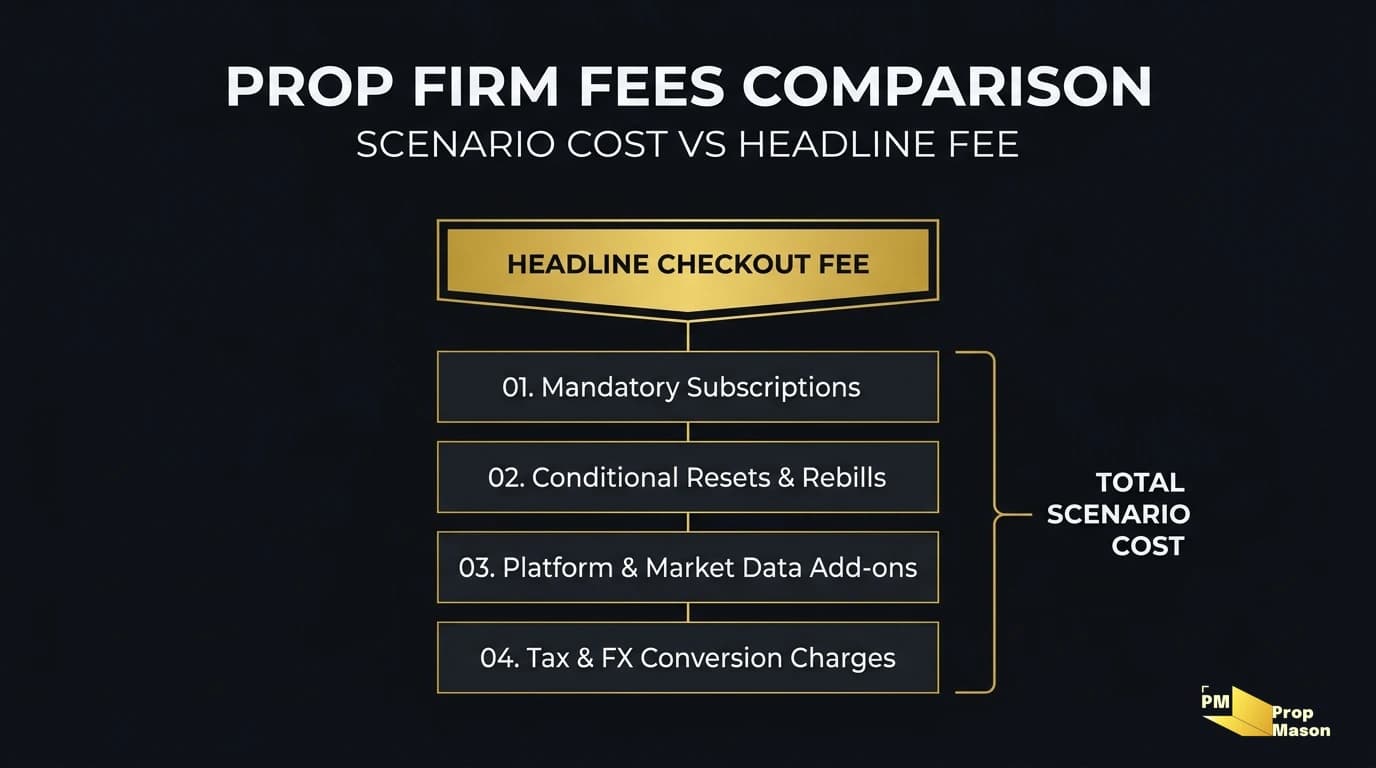
Two evaluations with low headline numbers can produce very different final expenses. FTUK Flex starts at $9, but FTUK's website explains that passing traders pay a separate activation fee before receiving simulated funding. In contrast, TradeDay Quick Pay Intraday bills on a monthly schedule with no activation fee.
When you look at passing traders, the total changes quickly. For FTUK Flex, adding the start price to the activation fee of $374 results in an all-in cost of $383. Paying for TradeDay Quick Pay Intraday across three billing cycles totals $393, just $10 above FTUK's all-in price. Which route costs less depends on whether and when the trader passes.
This comparison does not make one program cheaper for everyone. A trader who fails early and never passes pays only the entry fee at FTUK, making a pay-after-pass model lower in out-of-pocket cash for unsuccessful attempts. Pass rates remain unknown in our data, so neither design represents a universal bargain. Your pace matters. Decide whether your trading timeline favors a monthly versus one-time fee structure.
One month plus one reset, and three months billed
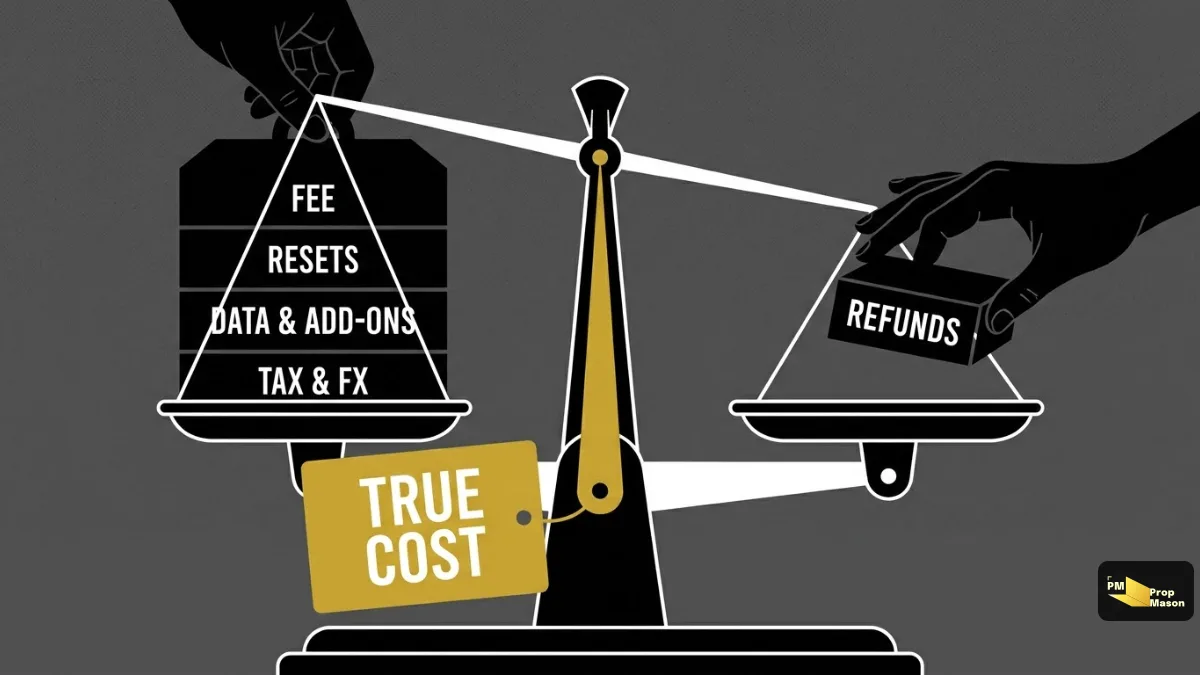
Every reset adds an extra charge, and every monthly subscription bills on a recurring cycle until you pass or cancel. Looking only at the checkout figure overlooks how quickly these events compound. The table below calculates combined out-of-pocket totals for programs with published reset fees and subscription rates, checked as of 8 October 2026.
| Scenario | Program | Total |
|---|---|---|
| One month plus one reset | TradeDay Quick Pay Intraday | $190 |
| One month plus one reset | TradeDay Fast Pass End of Day | $284 |
| Evaluation price plus one reset | Earn2Trade Gauntlet Mini | $245 |
| Three months billed | TradeDay Quick Pay Intraday | $393 |
| Three months billed | TradeDay Fast Pass End of Day | $567 |
| Three months billed | UProfit Day Soft | $234 |
| Three months billed | Take Profit Trader trading test | $510 |
The three-month total simply multiplies the monthly subscription by three billing cycles. Three months is an example. It is not a forecast of how long anyone takes to pass. Recurring monthly renewals quickly overtake one-time evaluation fees when a challenge takes longer to complete.
Certain programs carry additional charges not captured here. Take Profit Trader's homepage lists a one-time fee to open its PRO (funded) account, and PRO resets. Our data has no amount for either, so the three-month total understates its cost. None of these totals include sales tax, exchange data subscriptions, or withdrawal processing fees, which are not present in our data.
Monthly plan or one-time fee: which cost grows with your attempts
Futures programs in our dataset primarily bill on a monthly schedule, meaning calendar time drives your total expense. In contrast, forex and CFD challenges generally charge a single upfront payment, which means repeated attempts drive your cost instead of elapsed days.
Your choice hinges on how long you anticipate needing to meet the profit target. When you expect to reach the goal within a single month, monthly futures prop firms cost less up front. When you anticipate taking several months or restarting after rule breaches, the fixed purchase price of forex prop firms caps your exposure per trial. Reset costs for the forex and CFD challenges listed here are not in our data, requiring a fresh account purchase if an attempt ends.
Refund rules also divide the two models. FTMO states on its help portal that it labels the 2-Step fee "100% Refund with first payout" and the 1-Step fee "Non-refundable one-time fee". Meanwhile, FundingPips documents its 2-Step registration fee as "Registration fee refunded at 4th reward". A refund credited after a withdrawal does not lower your checkout barrier; you must still fund the test upfront. For traders weighing structure, review our comparison of one-step versus two-step challenges.
Currency differences also matter. FTMO bills in euros, spanning from €89 to €1,080 across its standard evaluation sizes, as verified on 12 October 2026. International card providers often apply foreign transaction fees or currency conversion spreads when paying in euros from a dollar-denominated account.
What each fee buys in loss room
The same registration fee purchases varying amounts of breathing room before a rule violation occurs. Dividing the entry charge by the maximum loss limit normalizes programs onto a common benchmark of fee per unit of risk allowance. However, this ratio reveals nothing about pass probabilities, because how the limit moves differs across firms. For example, TradeDay Quick Pay Intraday trails equity during the active trading session, whereas Take Profit Trader recalculates its trailing limit at the end of the day.
| Program | Market | Fee per thousand of max loss |
|---|---|---|
| TradeDay Quick Pay Intraday | Futures | $65.50 |
| Take Profit Trader trading test | Futures | $85 |
| The5ers High Stakes | Forex and CFD | $62.25 |
| FTMO 2-Step | Forex and CFD | €69 |
If your plan is for another account size
The tables above show the 50K size. At other sizes, the same three things decide the total: billing period, reset fee, and fee after passing, which the guides below cover per market.
| Your plan | Where to look next |
|---|---|
| You trade futures and want to compare more firms | Futures prop firms |
| You trade forex or CFDs | Forex prop firms |
| You are weighing one step against two | One-step versus two-step challenges |
| You are weighing a monthly fee against a one-time fee | Monthly subscriptions versus one-time fees |
| You are choosing between Topstep and Earn2Trade | Topstep versus Earn2Trade |
| You live in the United States | US prop firm guide |
| You want every firm PropMason tracks | Firm directory, or current offers on deals and coupons |
Four ways a cheap price misleads
Headline prices can mislead. Conditions in the rules alter what you ultimately pay. Evaluating an offer strictly by its checkout number creates several budgeting pitfalls.
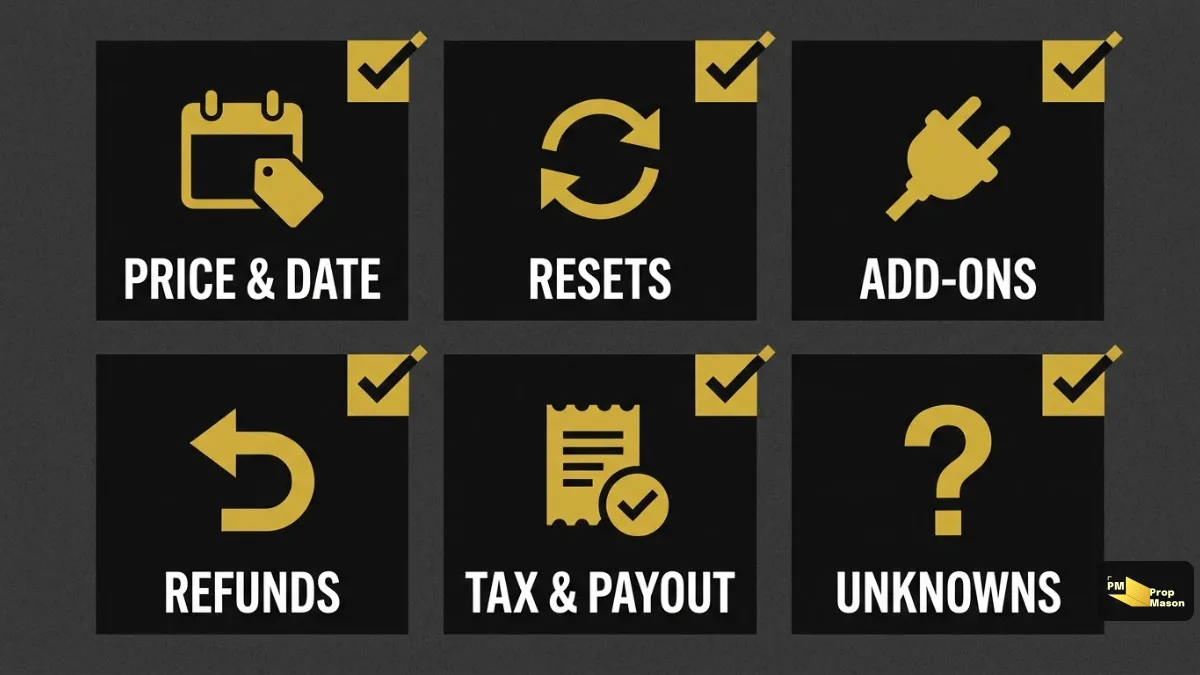
Promotional discounts distort ongoing expense projections when mistaken for regular rates. Both TradeDay and FundedNext run percent-off campaigns on their portals, so the tables above use list prices rather than discounted checkout figures that reset once a campaign concludes.
Unlisted fees skew calculations because treating an untracked charge as zero can only understate your true cost. Take Profit Trader's homepage lists a one-time fee to open its PRO (funded) account, and PRO resets. Our data has no amount for either, so the three-month total understates its cost. Similarly, our data tracks no billing cycle for Earn2Trade, no reset fee for UProfit, and no withdrawal fees for any firm.
Currency denomination creates another trap when comparing euro and dollar figures side by side. FTMO charges in euros, so weighing its numerical rate directly against US dollar challenges without factoring in foreign exchange conversion distorts the comparison.
Refund policies rarely function as upfront discounts, because the money goes out before any return occurs. FundingPips and FTMO return registration fees only after a trader meets specific payout milestones, which means the initial fee remains fully spent if you fail before qualifying for a distribution.
Related Reading
- Firm directory: Browse every evaluated firm and filter programs by market and platform.
- One-step versus two-step challenge: Compare target requirements and passing stages across evaluation models.
- Subscription versus one-time fee: Review how recurring monthly plans stack against single upfront purchases.
- Trading platforms used by prop firms: Examine software choices, charting capabilities and broker connections.
- Payout methods and thresholds: Check withdrawal minimums, processing schedules and payment providers.
- Deals and coupons: Inspect current discount codes and limited promotional offers.
Sources
- TradeDay pricing, read 13 October 2026.
- UProfit pricing, read 8 October 2026.
- The5ers futures pricing, read 12 October 2026.
- Earn2Trade Gauntlet Mini rules and fees, read 15 October 2026.
- Take Profit Trader plans, read 9 October 2026.
- FTMO challenges, read 12 October 2026.
- FundingPips evaluations, read 15 October 2026.
- FTUK Flex challenge, read 8 October 2026.
- CFTC consumer advice and NFA regulatory notices.
Disclosure and risk
PropMason may earn commissions from some links; see the affiliate policy. Commercial relationships do not change the order of firms or the wording about them on this page.
This page is not financial, investment, legal or tax advice.
Trading futures and forex carries a risk of loss. The CFTC and the NFA publish warnings and fraud advice for traders in the United States.
Read how PropMason checks and edits its pages in the editorial policy.
FAQ
Which prop firm has the lowest fees?
No single firm has the lowest fee for every trader. If you pass an evaluation within one month without failing, monthly futures programs offer low start costs, while one-time forex challenges prevent monthly renewals. When attempts stretch across multiple months or require resets, fixed-fee programs often total less than recurring plans. Total cost ultimately follows your passing speed, whether you breach a loss limit, and whether the program charges an activation fee after you pass.
How much is a 10K prop firm account?
Across our data for this size, FTMO charges €89 (billed in euros), The5ers charges $69, and Goat Funded Trader charges $65. FTUK starts at $9 at checkout, then charges an activation fee of $98 once you pass, bringing its combined total to $107.
Is there a free prop firm?
No evaluation in our tracked data is free to enter. Pay-after-pass programs like FTUK Flex start at $9 at checkout, but the firm bills an activation fee once you pass before funding begins. Every evaluation in our data requires payment either up front or upon passing. Compare all active programs in the prop firm directory.
Are prop firms really worth it?
Whether an evaluation justifies its expense depends on your strategy and the probability of reaching a payout. Entry fees, monthly subscriptions and resets are non-refundable out-of-pocket expenses unless you pass and secure a qualifying reward from a firm that offers a fee refund. Review how PropMason evaluates prop firms to compare rules before committing funds.
Next step
Pick one program from the key-facts table that fits your market and account size. Open its PropMason page, such as TradeDay or UProfit, verify its reset fee and billing period, and calculate your total cost using your own expected months and attempts.