Quick answer
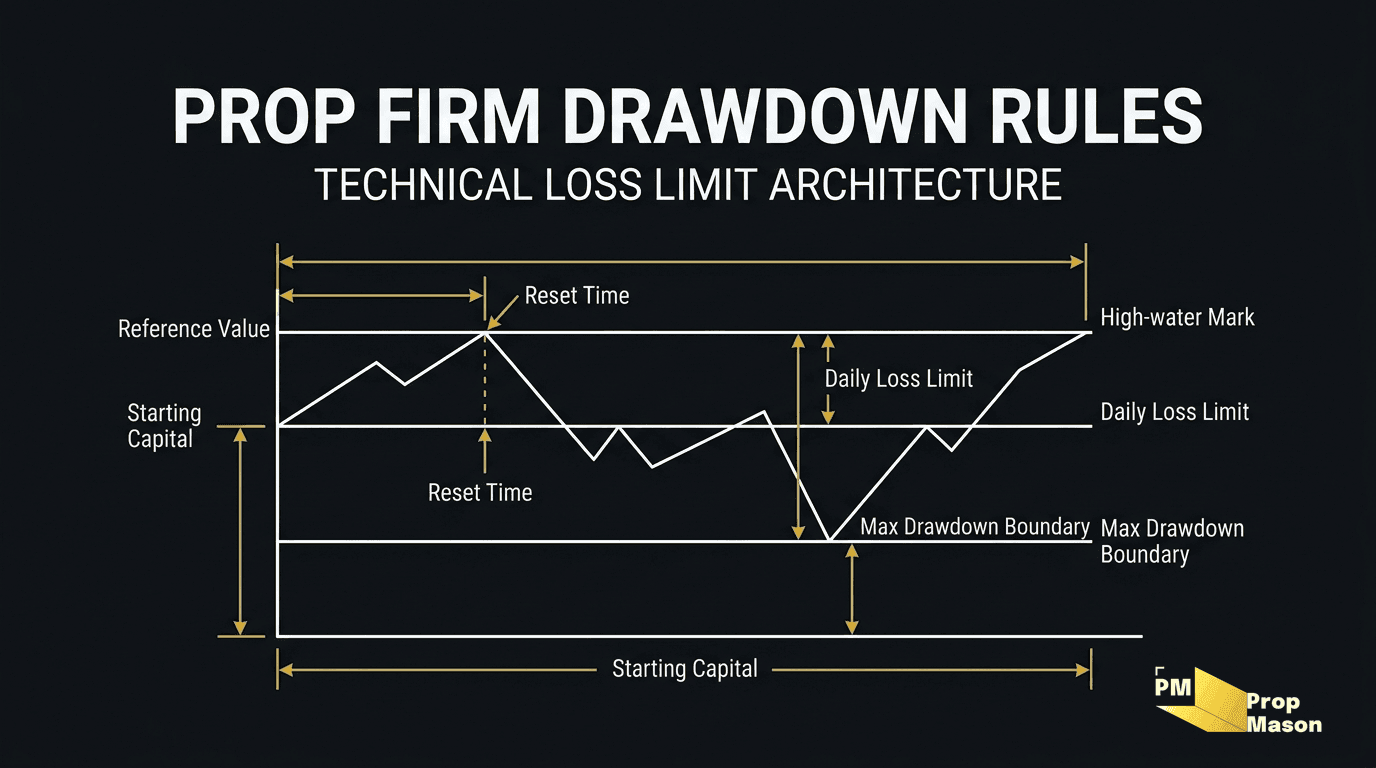
At its simplest, drawdown is how much the account can lose before it is closed. Prop-firm drawdown rules are not one formula. Read four fields separately:
- Reference value: starting balance, current balance, equity, realized profit or a high-water mark (the highest peak balance the account has reached).
- Update event: intraday, end of day or another scheduled reset, with the controlling time zone.
- Threshold formula: fixed distance, percentage, trailing distance, floor or lock point.
- Which number the firm checks (closed balance or live equity): whether the active limit is checked against balance, equity, floating loss (unrealized loss on open trades) or a closed result.
That record is more useful than a headline percentage. Daily loss and maximum loss may coexist with static, trailing or EOD mechanics, but they are separate fields until the official program rule connects them.
Worked example (hypothetical, not a specific firm's rule)
Consider a $100,000 account with a $3,000 end-of-day trailing loss limit. If Day 1 closes at $101,000, the floor moves up to $98,000. If Day 2 closes at $103,000, the floor moves to $100,000; on a program that locks at the starting balance, it stops there. On Day 3 the account dips to $99,800 during the session and closes at $102,000. If the firm compares the floor only at the close, the account survives. If it checks live equity against the floor, as Topstep does, the account is closed the moment equity touches $100,000. That is why the breach test in the checklist below matters as much as the update time.
Drawdown types to distinguish
- Daily loss: the loss limit for a trading day or reset cycle; verify the reset time and whether floating loss counts.
- Maximum loss: the broader account loss limit; verify its balance or equity basis and whether it moves.
- Static drawdown: a fixed threshold that does not follow new highs under the named model.
- Trailing drawdown: a threshold that can move with account balance, equity or a high-water mark.
- EOD drawdown: a model that updates a reference or threshold at a defined end-of-day event. EOD describes timing; it does not by itself prove that intraday equity is ignored.
- Daily relative drawdown: a daily loss limit that recalculates relative to the starting balance or equity of that specific trading day.
Do not infer the breach test from the label. The rulebook must state the reference, update event, threshold and observation basis.
Balance, equity, update and breach are separate
Balance usually reflects closed trades; equity can include open profit or loss. A program may use one value to update a threshold and another to test the active limit. That is why “EOD” alone cannot answer whether an open position can breach during the session.
| Field | Question to answer | Why it matters |
|---|---|---|
| Reference | What value sets the starting point or high-water mark? | It determines the threshold's base. |
| Update event | When does the reference or threshold change, and in which time zone? | The same clock label can mean different moments for different programs. |
| Formula | Is the distance fixed, percentage-based, trailing, floored or locked? | The displayed percentage is incomplete without the formula. |
| Which number the firm checks (closed balance or live equity) | Does balance, equity, floating loss or a closed result trigger the rule? | It determines whether an open trade matters before it is closed. |
Dated examples, not universal rules
TradeDay offers Intraday and End of Day trailing drawdown options, with trailing maximum drawdown ranging from $1,000 to $4,500 by account size, calculated intraday on the Intraday cards (observed on its homepage on 28 September 2026). FTMO's 1-Step Trading Objectives page, observed on 28 September 2026, describes Maximum Loss as a trailing end-of-day calculation at 00:00 CE(S)T and separately states that equity cannot fall below the active limit. These are named program examples, not a single industry standard.
Earn2Trade's Gauntlet Mini page displays GAU50 (its $50,000 evaluation account) EOD Drawdown of $2,000 and Daily Loss Limit of $1,100. That card does not, by itself, establish the complete high-water, breach or payout formula.
For traders comparing current rules across major firms:
- Topstep uses an EOD trailing maximum loss limit of $2,000, $3,000, or $4,500 (locking permanently at the starting balance once reached) alongside an optional daily loss limit, chosen at checkout, of $1,000, $2,000, or $3,000 across its $50K, $100K, and $150K Trading Combine accounts.
- Apex Trader Funding offers both intraday trailing and EOD trailing drawdown accounts, with maximum trailing drawdowns from $1,000 to $4,000 across its 25K to 150K plans.
- Take Profit Trader uses an EOD trailing drawdown of $1,500 to $4,500 during its Trading Test, which stops trailing once it reaches the original starting balance.
Academy learning path
Start with this guide to learn how to read the rules. Then use the narrower pages for trailing drawdown, EOD drawdown, consistency rules and weekend holding policies. Use prop firm payout rules for payout-specific conditions, not as a substitute for a drawdown formula.
Checklist before buying a challenge
Record these fields for the exact program and stage:
- reference value and starting balance;
- daily-loss and maximum-loss formulas;
- balance, equity, realized-profit and floating-loss treatment;
- update event, reset time and time zone;
- threshold distance, floor or lock point;
- breach observation and whether open trades count;
- payout, withdrawal, news, overnight and weekend interactions;
- the page link and the date you read it.
If a field is absent or ambiguous, keep it unknown instead of filling it with a community assumption.
Common mistakes
Do not look only at the headline percentage. A 5% rule on one firm can be a fixed floor below your starting balance, while on another it is a trailing threshold or a daily limit calculated from a completely different reference.
Do not assume a drawdown model is safer or better for your strategy until you compare the exact starting balance, usable loss budget, update timing, and whether live equity triggers a breach. What fits one trader's style can fail another under different rule mechanics.
Do not assume that taking a payout or withdrawal leaves your drawdown buffer unchanged unless you have verified how your specific program recalculates the account floor after a payout.
Related Reading
Read PropMason Academy for foundational terms. Continue to trailing drawdown, EOD drawdown, consistency rules, weekend holding policies, and prop firm payout rules. For direct comparisons and tool support, see Trailing vs EOD Drawdown and the Drawdown Simulator.
Sources and methodology
The dated examples in this guide use official pages checked on 28 September 2026:
- TradeDay homepage: Intraday and End of Day trailing drawdown options, $1,000 to $4,500 ladder by account size, calculated intraday on Intraday cards.
- TradeDay how it works: named evaluation context only.
- FTMO Trading Objectives: FTMO 1-Step Maximum Loss, Maximum Daily Loss, 00:00 CE(S)T update and equity-breach wording.
- Earn2Trade Gauntlet Mini: displayed GAU50 EOD Drawdown and Daily Loss Limit fields; not a complete payout or breach formula.
These sources support scoped examples, not an industry-wide drawdown definition. If a page changes, check it again before relying on this example. PropMason may receive a commission from links; see the affiliate policy. This guide is educational and does not provide financial, legal, tax or investment advice.
Trading futures and forex carries a risk of loss. In the United States, the CFTC and the NFA publish fraud warnings and guidance for traders.
Read how PropMason scores firms in the methodology and how we check and edit pages in the editorial policy.
FAQ
What is the first thing to record in a drawdown rule?
Record the exact program and stage, reference value, update event and time zone, threshold formula, breach observation basis and official source date. A percentage without those fields is incomplete.
Can an EOD rule still breach during the trading session?
It can, depending on the program. EOD may describe when a reference or threshold updates, while the active limit may still be tested against balance or equity during the session. The official breach wording controls.
Are daily loss and maximum loss the same as drawdown?
No. Daily loss usually applies to a declared day or reset cycle, while maximum loss is the broader account limit. Static, trailing and EOD describe other threshold mechanics; a program may combine them, but the rulebook must say how.
Does a withdrawal always reduce drawdown margin?
No universal answer is supported. A withdrawal may change account values in some programs, but the effect depends on the exact account and payout calculation. Verify the official policy rather than assuming a reset or reduction.
Which drawdown model is best for a trading strategy?
Static overall drawdown is often considered the most forgiving because your floor stays fixed at a set amount below your starting balance, rather than trailing upward as you make profits. However, there is no evidence-free universal winner across every strategy. Compare the same starting balance, usable loss budget, reference, update event, open-equity treatment and breach trigger, then decide whether the model's documented conditions match the intended activity.
What is Topstep's drawdown policy?
Topstep uses a Maximum Loss Limit that trails your end-of-day balance: $2,000 on a 50K account, $3,000 on 100K and $4,500 on 150K. Topstep's help page says the limit is watched in real time and locks once it reaches your starting balance.
Which prop firm has no daily drawdown?
On PropMason's Leeloo Trading page, Leeloo lists no daily loss limit. Its accounts still have a trailing maximum loss, so one bad run can still end the account.
Next step
Before paying for a challenge, verify the exact prop firm drawdown rules on the official program page and compare like-for-like stages. Keep missing or conflicting values unknown until the source owner resolves them.