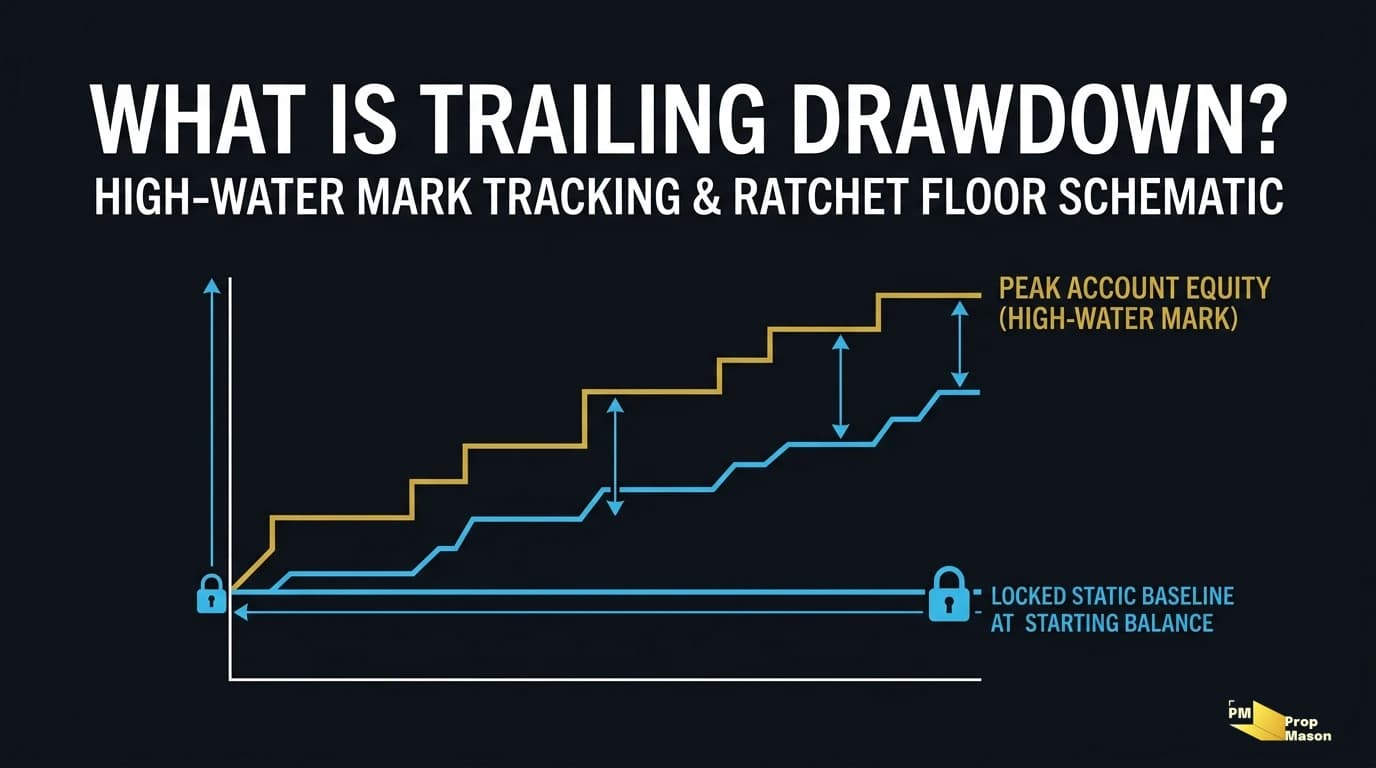
Definition: Trailing drawdown is a prop firm loss limit that can move upward as the account grows. Unlike a fixed (static) limit, the allowed-loss floor may be recalculated from balance, equity, or end-of-day value, which changes the real risk buffer even when the stated percentage is identical.
How trailing drawdown works
A complete formula needs more than the word "trailing" and a percentage. Record nine fields:
- Reference value: whether it tracks account balance or account equity
- Peak type: whether the high point comes from closed trades or intraday highs
- Trail amount: whether the loss distance is a fixed dollar amount or a percentage of the peak
- Update timing: whether the floor updates in real time or at the end of the trading day
- Treatment of open equity: whether unrealized open profits move the floor upward
- Lock or freeze point: whether the trail stops at starting balance or continues trailing forever
- Breach comparison: whether breach liquidation happens intraday or on the closing balance
- Account stage: whether rules differ between evaluation and funded stages
- Source date: the date the rules were verified on the firm's website
Two common formula families are:
- Percentage of current high: floor = current high - (percentage x current high).
- Fixed distance from current high: floor = current high - fixed trail amount.
Neither formula says whether "current high" means balance, realized high, intraday equity or EOD snapshot. That definition comes from the exact rulebook.
The table below shows how a $100,000 account with a fixed $6,000 trailing distance (6% of the $100,000 starting balance) behaves as equity changes:
| Step | Account equity | Peak equity | Loss floor | Risk buffer |
|---|---|---|---|---|
| 1. Account start | $100,000 | $100,000 | $94,000 | $6,000 |
| 2. Gain to $105,000 | $105,000 | $105,000 | $99,000 | $6,000 |
| 3. Pullback to $101,000 | $101,000 | $105,000 | $99,000 | $2,000 |
The floor moves up to $99,000 when equity hits $105,000. When equity drops back to $101,000, the floor stays at $99,000. That leaves only $2,000 of risk buffer instead of the original $6,000.
Official examples show different trailing models
Official pages checked on 28 September 2026 show why "trailing drawdown" is a family of formulas:
| Official source | What the page says | What the example proves |
|---|---|---|
| Maven Trading FAQ | Percentage of the highest equity point. Its example moves from $1,000 equity with a 3% trail to a $1,100 high, recalculates the trail as $33 and states a breach below $1,067. | A percentage-of-current-high rule changes both the floor and the dollar distance. |
| TradeDay pricing | Homepage offers an Intraday or End of Day choice, listing "Trailing Max Drawdown $1,000 / $2,000 / $3,000 / $4,500 (calculated Intraday)". | A firm can offer both Intraday and End of Day trailing drawdown options. |
| Leeloo Trading support | LTMAB/ALTV tracks the highest unrealized profit intra-trade; an 8-contract example says the max drawdown might be $2,500. | A model can combine an intraday equity high with a dollar-denominated trail amount. |
| Earn2Trade Gauntlet Mini | The $50,000 account card lists "EOD Drawdown $2,000" for evaluation and "Trailing Drawdown $2,000" for Funded Live. | Some program cards publish a dollar trail rather than a percentage, but the card alone does not define every movement rule. |
These are dated program examples, not universal rules or recommendations.
Does Topstep have a trailing drawdown?
Yes. Topstep uses an end-of-day trailing limit called the Maximum Loss Limit. The limit updates at the end of each trading day based on your closing balance, but Topstep monitors breaches in real time throughout the session using unrealized profit and loss. The trailing distance is $2,000 for a $50K account, $3,000 for a $100K account, and $4,500 for a $150K account. Once the limit reaches your starting balance, it locks permanently.
Traders also ask whether Apex Trader Funding has a trailing drawdown. Apex sells both intraday trailing and end-of-day trailing evaluations. On its intraday evaluations, the trailing threshold tracks your peak balance in real time, including open unrealized profit. The trailing distance is $1,000 for a 25K account, $2,000 for a 50K account, $3,000 for a 100K account, and $4,000 for a 150K account, and the end-of-day evaluation uses the same dollar amounts.
For where the trail stops on each platform and account type, see the firm's intraday trailing drawdown guide.
Take Profit Trader uses an end-of-day trailing drawdown on its test accounts. According to its test rules article, the limit calculates only at the end of the trading day, but account liquidation is checked in real time. The drawdown amount is $1,500 for 25K, $2,000 for 50K, $2,500 for 75K, $3,000 for 100K, and $4,500 for 150K. The floor stops trailing once it reaches the original starting balance.
On the funded PRO account, the rule shifts. Its PRO rules article states that the drawdown trails intraday on peak balance including open profit, using the same dollar amounts and still stopping at the starting balance. On PRO+, the drawdown switches back to end of day.
Trailing vs. static vs. EOD drawdown
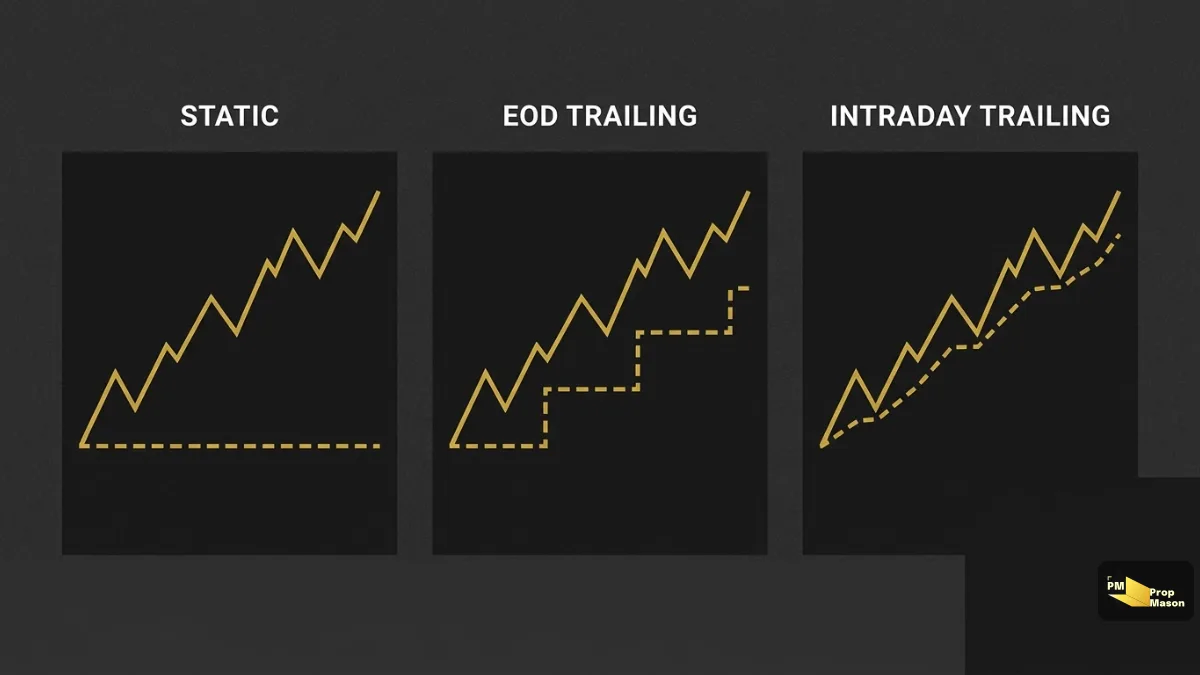
| Rule family | Reference and update | What remains program-specific |
|---|---|---|
| Static | Fixed threshold, often tied to starting balance | Inclusive breach wording and stage changes |
| EOD trailing | A realized balance snapshot at a stated session close | Timezone, trail amount, freeze point and treatment of withdrawals |
| Intraday trailing | Balance or equity high updated during the session | Open-profit treatment, fixed vs percentage trail, lock point and tick-level breach |
Apex and Topstep provide one concrete contrast: Apex's intraday threshold follows peak balance including open profit in real time, while Topstep's limit updates only on the end-of-day balance. Do not generalize that timing to another firm.
Two formula examples that must not be mixed
Source-backed percentage example: Maven's FAQ starts with $1,000 equity and a 3% trail. At a $1,100 highest-equity point, 3% is $33, so the stated breach floor is below $1,067.
Fixed-distance illustration: if a rule explicitly defines a fixed $5,000 trail from a $103,000 high, the arithmetic floor is $98,000. This is a formula illustration, not a claim about a named program. Before using it, the rulebook must confirm the $5,000 distance, reference high, update timing and breach wording.
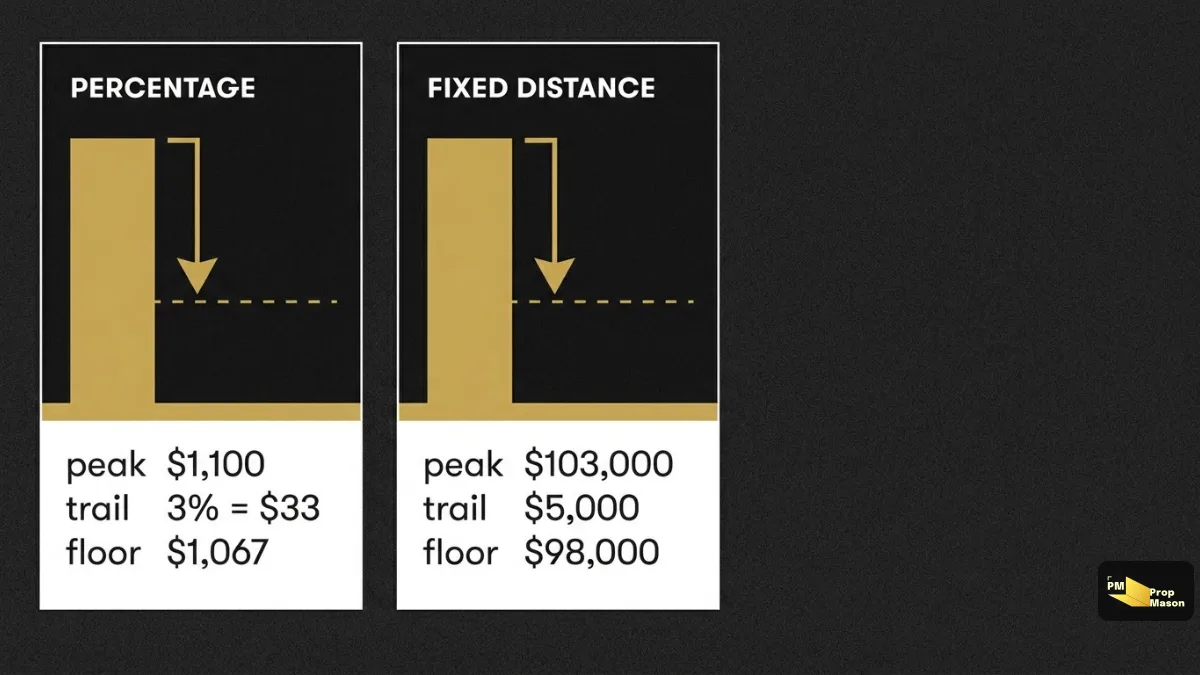
These two formulas are often confused: $97,850 is 5% below $103,000, while $98,000 is a fixed $5,000 distance. Both calculations can be valid under different rules; neither is a universal 5% trailing formula.
When trailing drawdown locks
A lock point is program-specific. Topstep's rulebook states that its Maximum Loss Limit locks permanently at the account starting balance. That source supports this scoped example only; it does not prove every trail locks or that every stage uses the same floor.
If the official page does not state a lock, cap or freeze point, keep the field unknown. Do not infer one from a dashboard graphic or another account type.
Why trailing drawdown narrows the buffer
Trailing drawdown can make a profitable account feel tighter than expected. A trader earns profits, the floor rises, and there is less room for normal strategy variance on the next sequence.
This is particularly relevant for:
- Strategies with large floating drawdown before closing a trade
- Wide-stop approaches where open equity dips before recovering
- High intraday volatility styles where the equity curve zigzags upward
Before choosing between evaluation and instant-funded account types, compare which drawdown rule applies at each stage. See instant funding vs challenge for how those paths differ.
What to verify before paying
- Starting balance and maximum loss amount (absolute dollar, not just percentage)
- Whether the drawdown follows balance, equity, or end-of-day value
- Whether it locks after a threshold, and at what level
- How open positions affect the calculation (does floating equity count?)
- What counts as a breach (close-of-bar, tick-level equity, or something else)
- Whether rules differ between evaluation and funded stages
- Model the drawdown floor after a sequence of winning trades
- Compare trailing vs. static vs. EOD rules for the same firm side by side
- Save the official rulebook example and note the access date
If any field is missing from the rulebook, request written confirmation from support and save it with the access date before trading.
Browse the prop firm directory and verify each exact program source before comparing drawdown fields.
Common mistakes
Many traders compare only account size and profit target, missing the drawdown rule that can end the challenge fastest. A trailing rule at 5% can be meaningfully stricter than a static rule at 5%, depending on how the trail moves.
Another common error is assuming all trailing drawdown rules work the same way. The calculation method, what triggers the trail, and whether there is a stop point can change strategy fit entirely.
For the broader loss-limit framework, see prop firm drawdown rules.
Related reading
- Prop firm drawdown rules for the parent framework.
- Trailing vs EOD vs static drawdown to compare the three models.
- Drawdown simulator to model trailing and static loss limits.
Sources and methodology
This guide relies on each firm's own rulebooks and help pages, read on the dates shown below.
-
Official pages: Maven Trading FAQ, TradeDay pricing, Leeloo Trading support, Earn2Trade Gauntlet Mini, Topstep Maximum Loss Limit, Apex Trader Funding help center and Apex intraday trailing drawdown guide, checked on 28 September 2026.
-
Method: separate reference value, peak type, trail amount, update timing, open-equity treatment, lock point, breach wording and stage. A missing field stays unknown.
-
Program pages change. Check the current rulebook before you trade.
-
PropMason may earn commissions from some links; see the affiliate policy. Commercial relationships do not change the evidence standard.
-
This content is educational and does not promise passing, funding, payout or profit.
Trading futures and forex carries a risk of loss. In the United States, the CFTC and the NFA publish fraud warnings and guidance for traders.
Read how PropMason scores firms in the methodology and how we check and edit pages in the editorial policy.
FAQ
What is trailing drawdown?
It is a moving loss threshold whose formula depends on the reference high, trail amount and update timing. The label alone does not reveal whether the rule follows balance, realized profit, intraday equity or an EOD snapshot.
Is a fixed $5,000 trail the same as 5% of the high?
No. At a $103,000 high, a fixed $5,000 distance gives a $98,000 floor, while 5% of $103,000 gives a $97,850 floor. Use only the formula stated by the exact program.
Does trailing drawdown always stop moving?
No. Some programs define a freeze or lock point; others may continue trailing. Topstep's limit locks permanently at the starting balance, but that cannot be generalized.
Is trailing or static drawdown better?
At the same dollar amount, static drawdown leaves more room, because the floor does not rise with profits. Trailing drawdown ratchets up with your highest balance or equity, which requires stricter risk management to avoid giving back open gains.
What should I verify before trading?
See What to verify before paying for the complete checklist of rules and parameters to confirm.
Is trailing drawdown good or bad?
Neither by itself. It protects the firm by raising your floor after gains, which can leave you less room after a winning run. It suits traders who take profits quickly more than traders who let open trades swing.
How does end-of-day trailing drawdown work?
The floor moves only at the daily close, based on your closing balance. At Topstep, for example, the limit updates at the end of each day but is still checked in real time, so an open loss during the session can end the account.
Which prop firms offer no trailing drawdown?
On PropMason's pages, FTMO's 2-Step Standard uses a static 10% maximum loss and Funded Trading Plus's 2-Step Classic uses a static 8% maximum loss. Their one-step programs trail.
Next step
Model the exact trailing drawdown rule with the firm's own numbers before trading. If any formula field is missing or conflicts across official pages, keep it unknown and request dated written clarification rather than relying on an assumed 5% calculation.
No financial advice
This article is for educational and research purposes. PropMason is not a financial advisor, broker or prop firm. Verify current terms directly and do not treat any example as a guarantee of payout or trading results.