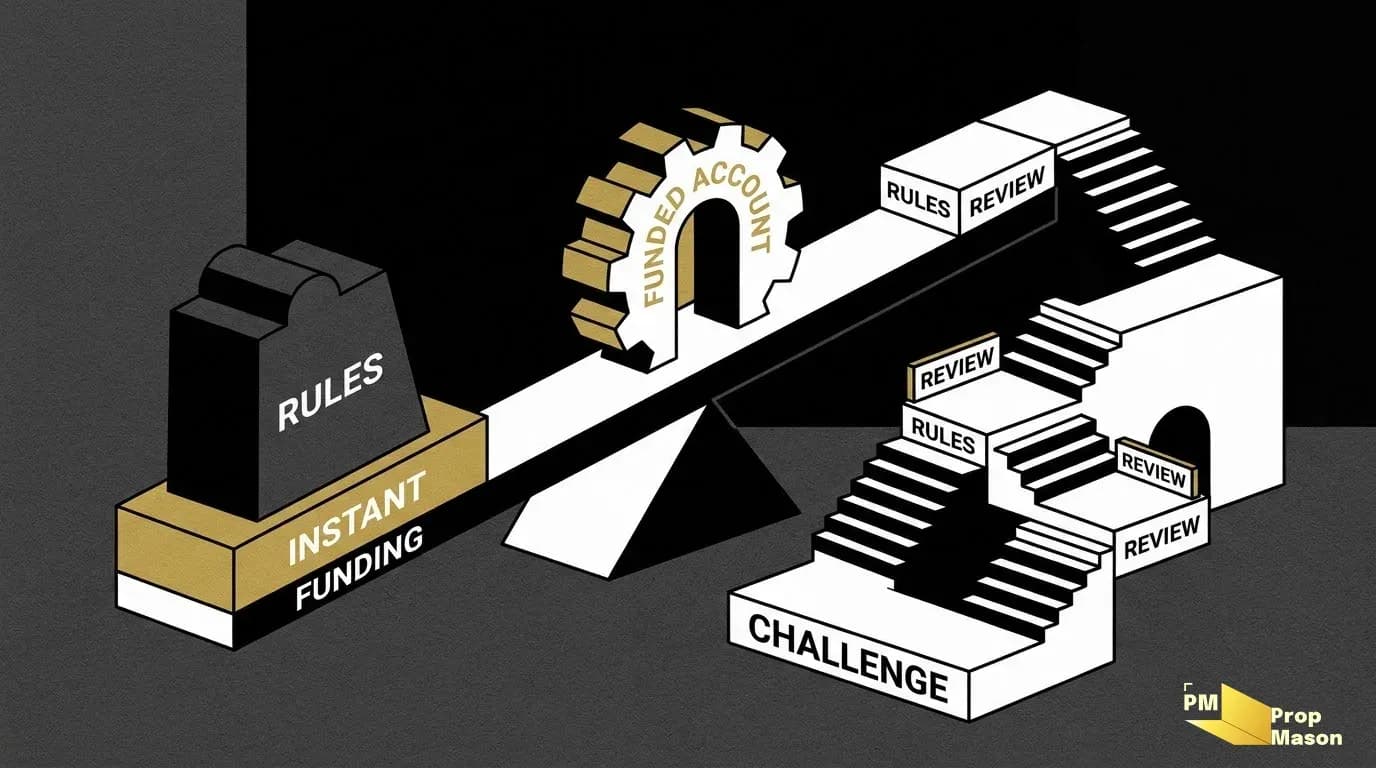
Blue Guardian, Instant Funding, FTUK, Funded Trading Plus and Maven Trading all describe their instant accounts as simulated or demo services (checked 2026-09-28): "funded" is the firm's label for the account, not real firm capital. For dated prices and rules by firm, see the instant funding comparison.
Short answer
Instant funding often appeals because it shortens or removes the evaluation phase. But speed can come with higher fees, tighter drawdown, stricter payout review or more breach conditions.
Traditional challenges are usually slower because traders must pass one or more phases. In exchange, profit targets, daily loss, max loss, reset and refund policies are often easier to see.
The right question is not “which model is faster”. The right question is which rule set matches how you trade.
Methodology: compare total rule burden
PropMason reads instant funding and challenges across six groups:
- Access speed: immediate account, one phase, two phases or funded stage after evaluation.
- Total cost: upfront fee, reset, retry, activation, subscription and platform/data fees.
- Risk rules: daily loss, max loss, trailing/EOD/static drawdown and consistency rules.
- Payout rules: first payout, minimum payout, profit split, KYC, review and payout cycle.
- Strategy restrictions: news, weekend holding, EAs, copy trading, HFT, lot size and inactivity.
- Evidence quality: pricing page, rulebook, payout policy, help center and access date.
If official data is missing, the article should keep caveats instead of concluding that instant funding or challenges are better.
Quick comparison
The table shows how the two models usually differ on five criteria; the last column says what to verify for your program.
| Criterion | Instant funding | Challenge | Verify |
|---|---|---|---|
| Speed | Usually faster | Usually requires evaluation phases | Account setup and funded-stage rules |
| Cost | May be higher upfront | May be cheaper but include reset/retry | Total cost of funding |
| Drawdown | May be tighter | Depends on phase and account type | Daily loss, max loss, drawdown basis |
| Payout | May have stricter review | Depends on funded stage | First payout, minimum payout, KYC |
| Strategy fit | Restrictions need close reading | Rules vary by phase | News, EA, copy trading, weekend |
When instant funding can mislead
Faster does not mean lower risk. Traders may access an account faster but be limited by narrow drawdown, strict payout rules or strategy restrictions.
Upfront fee is not total cost. Add platform fees, data fees, activation fees, reset/retry or opportunity cost if payouts are delayed.
A funded label does not guarantee payout. Payout still depends on rule compliance, KYC, minimum payout, review and breach conditions.
When a traditional challenge may fit better
A challenge may fit traders who want to test the rule set before entering the funded stage. It may also fit when pricing, reset/refund, profit target and payout path are published more clearly.
However, more phases also mean more chances to breach rules. Traders should read each phase separately instead of relying on account size or profit split headlines.
How to decide by trader profile
Pick the profile closest to how you trade and read its rules before you pay.
- Beginners: usually need clear rulebooks, understandable refund/reset terms and drawdown rules that are not vague.
- Scalpers/day traders: should check news, lot size, latency, HFT and platform restrictions before prioritizing access speed.
- Swing traders: should read weekend holding, daily loss, trailing/EOD/static drawdown and inactivity rules.
- EA/copy traders: should verify automation policy, copy trading terms, VPS support and strategy limits.
- Traders who need faster payouts: should read first payout, minimum payout, payout cycle, KYC and review process; fast funding does not mean fast withdrawals.
Checklist before paying
Run through this checklist for the exact program before you pay, and stop at any line you cannot confirm from an official page.
- Are the rulebook and pricing page official and easy to access?
- Have you counted upfront fee, reset/retry, activation, subscription and platform/data fees?
- Is drawdown trailing, EOD or static? Are daily loss and max loss based on equity or balance?
- Are first payout, minimum payout, KYC and payout review clear?
- Does your strategy conflict with news, weekend, EA, copy trading, HFT, lot size or inactivity rules?
- Are refund/reset conditions published clearly?
- Is there a source access date, and should sources be refreshed before a real decision?
Related Reading
- Best instant funding prop firms for a dedicated instant-funding checklist.
- What is instant funding? for foundational rules and mechanics.
- One-step vs two-step challenge to compare evaluation models.
- Prop firm fees comparison to calculate total funding cost.
- Trailing vs EOD vs static drawdown to read risk rules before choosing.
- MT5 vs cTrader to check platform and strategy restrictions.
- Scaling plans to read post-funded conditions.
- Firm directory to compare firms side by side.
Source caveat and freshness limit
Instant funding and challenge terms can change by account type, platform, region and campaign.
Before comparing specific firms, traders should refresh pricing page, rulebook, payout policy, refund/reset policy, KYC/restricted-country page, platform page and help center.
This article does not promise passing, payout, funding, profit or suitability.
Sources and methodology
PropMason rates firms with its published scoring model.
- Instant Funding trading rules: hard-breach and KYC/AML rules, checked 5 October 2026.
- Funded Trading Plus risk review policy: which account milestones trigger a risk review, checked 5 October 2026.
- Official pricing, rulebook, payout, refund/reset, platform, KYC and restricted-country pages can change; verify them near your decision date.
- This article avoids certainty claims about funding, payout, profit, pass rate or best model.
- Missing fields remain caveated until refreshed from official sources.
Trading futures and forex carries a risk of loss. The CFTC and the NFA publish warnings and fraud advice for traders in the United States.
Read how PropMason checks and edits its pages in the editorial policy.
FAQ
Is instant funding better than a challenge?
Not automatically. Instant funding is faster but may be more expensive, have tighter drawdown or include stricter payout review.
Is a challenge cheaper?
There is no universal answer. Compare upfront fee, reset, retry, refund, activation, platform/data fees and payout rules.
Does a funded account guarantee payout?
No. Payout depends on rule compliance, KYC, minimum payout, review and payout policy.
Should I choose by speed or rules?
Choose by rule fit. Speed only helps if cost, drawdown, payout and strategy restrictions match how you trade.
Is this financial advice?
No. This is educational content and a rule-checking checklist.
How legit is instant funding?
This page gives no verdict on any firm. The firms checked here describe their instant accounts as simulated, and payout still depends on each program's rules, identity checks and review. Read the payout rules before you pay.
Does instant funding pay out?
Only when the program's rules are met. Payout still depends on drawdown and breach rules, identity checks, minimum payout and review. Funded Trading Plus, for example, runs a risk review on withdrawal requests from simulated-live accounts.
Next step
When evaluating instant funding vs challenge accounts, use PropMason to compare total cost, drawdown, payout, strategy restrictions and the latest official sources before paying.