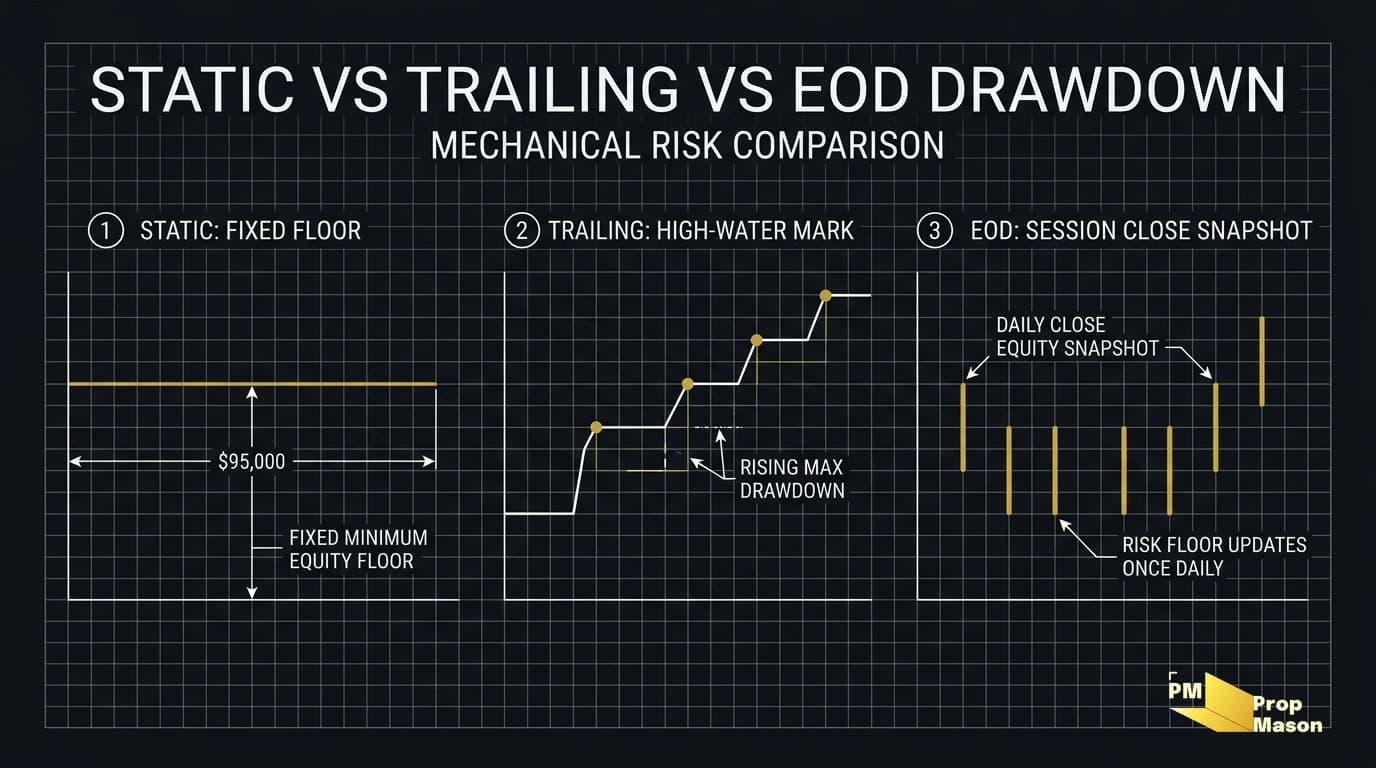
Quick answer
Static drawdown uses a declared maximum-loss floor that does not trail under that model. Trailing drawdown can move the floor when a declared balance, realized-profit or equity high changes. EOD drawdown describes an update schedule: the threshold may be recalculated from a declared end-of-day value rather than every intraday movement.
The same trade path can therefore produce different outcomes. A page is not sufficiently documented for an initial comparison until it states the reference value, fixed-dollar or percentage distance, update event, open or closed P&L treatment, floor or lock point, breach comparison, account stage and source date. Daily loss is a separate rule layer unless the program says otherwise.
How to read drawdown as an operating rule
Use this field order for each program:
- Model and stage: static, intraday trailing, EOD trailing or hybrid; evaluation, funded or another stage.
- Reference value: starting balance, current balance, realized high, equity high or an end-of-day snapshot.
- Distance: fixed dollars, percentage of a reference high or another declared formula.
- Update event: each tick, trade close, session close, timezone, or a specified lock point.
- Loss treatment: whether floating loss, commissions and open positions count.
- Breach rule: below, at or below, liquidation, account termination or another exact wording.
- Other layers: daily loss, consistency, payout, withdrawal and stage-transition effects.
If a rulebook, dashboard and support page conflict, preserve the conflict and record the update path if the source changes. Do not fill a missing field from a different firm.
Quick comparison by model
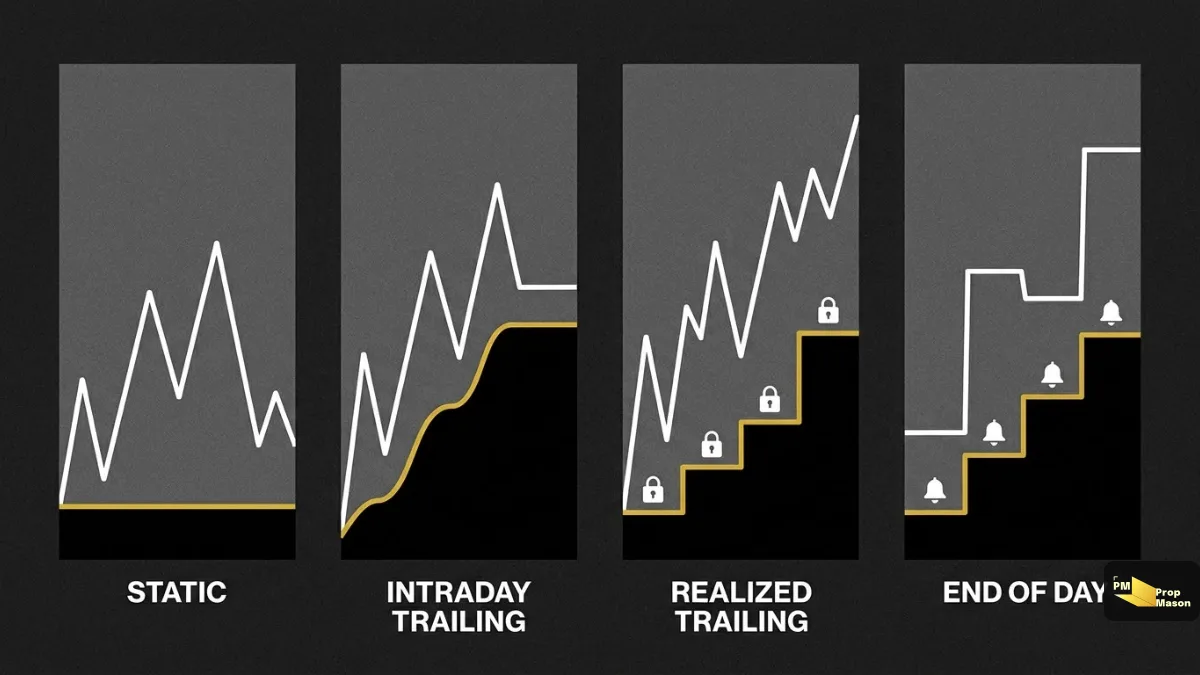
The table splits trailing drawdown into intraday and balance-based versions, so it compares four models by reference value and update time; the last column lists what stays program-specific.
| Model | Reference and update | What the reader can compare | What remains program-specific |
|---|---|---|---|
| Static maximum loss | A declared starting-balance or fixed floor that does not trail under the stated model | Whether profits leave the maximum-loss floor unchanged | Daily-loss resets, stages, payout effects and breach wording |
| Intraday equity trailing | A balance or equity high can update during the trading session | Whether floating profit raises the reference and how far the floor trails | High-water definition, commissions, lock point and exact breach trigger |
| Balance or realized-profit trailing | A closed balance or realized high updates when the program says it does | Whether unrealized profit is excluded until realized | Update event, reference field and stage-specific floor |
| EOD trailing or hybrid | A declared end-of-day snapshot recalculates the threshold at a stated time | Whether the snapshot uses balance, realized P&L or equity | Timezone, open-position treatment, freeze point and payout effect |
Worked example with declared assumptions
This is a PropMason hypothetical example, not a firm rule. Start with a $100,000 account and a $5,000 maximum-loss distance. Assume the breach occurs when equity falls below the declared floor.
- Static: the floor remains $95,000 under the declared maximum-loss model. A later profit does not move that floor.
- Intraday equity trailing: if the declared high-water equity reaches $102,000 and the fixed trail is $5,000, the illustrative floor becomes $97,000 while that high remains active.
- EOD trailing: if the program records a $102,000 realized balance at its stated close, the illustrative next-session floor becomes $97,000; an unrealized intraday high would not change it under this assumption.
These numbers demonstrate why the same later loss can be safe under one declared model and a breach under another. They do not establish that every firm uses a $5,000 trail, a $102,000 reference or the same close time.
When drawdown is easy to misunderstand
Daily loss is not automatically maximum drawdown. Daily loss may reset at a timezone-defined event while maximum drawdown follows a different floor. Treat both as separate fields.
EOD is not automatically static. EOD identifies when a value is sampled; the sampled value and the resulting floor still require the exact rule.
Floating profit can change the result. Some intraday models use open equity; others use balance or realized profit. Do not transfer one model's treatment to another.
Trading permission is not drawdown mathematics. News, weekend or overnight rules may create gap risk, but they do not prove how a threshold is calculated.
Match the model to your trading behavior
Use this as a fit screen, not a winner table. A row is usable only after the exact program and stage confirm the reference, update event, lock point, open-P&L treatment and breach wording.
| If your process depends on... | Model to inspect first | Why it may fit | Stop the comparison when... |
|---|---|---|---|
| A predictable fixed maximum-loss floor | Static | The declared floor may be easier to budget around because later profit does not trail it under that model | Daily loss, stage changes or withdrawal effects are missing or conflict with the maximum-loss rule |
| Monitoring unrealized highs in real time | Intraday equity trailing | It can be workable when you can track whether open profit raises the high-water reference before a trade closes | The source does not state whether open equity moves the reference or exactly when a breach occurs |
| Letting closed profit update the reference | Balance or realized-profit trailing | It may fit a process that separates realized gains from intraday unrealized movement | The rule does not identify which closed-balance event updates the floor or whether it later locks |
| Planning around a declared session snapshot | EOD trailing or hybrid | It may fit when the snapshot time, timezone and treatment of open positions are explicit enough to plan around | The snapshot value, timezone, open-position treatment or next-session floor is not stated |
This matrix does not make one model safer or easier. It narrows the next check: choose the row closest to how you manage positions, then verify every stop-condition field in the current rulebook before paying.
Related Reading
- Prop firm drawdown rules for each firm's own drawdown rules.
- What is trailing drawdown? for the trailing glossary.
- Prop firm fees comparison for scenario cost.
- Prop firm payout rules for payout timing and thresholds.
- One-step vs two-step challenge for stage context.
- Affiliate policy for disclosure and editorial independence.
Sources and Methodology
PropMason rates firms with its published scoring model.
The following official captures were checked 2026-09-28. They are examples of different implementations, not a ranking:
- Maven Trading FAQ gives a 3% highest-equity example from $1,000 to $1,100 and a $1,067 floor.
- TradeDay offers Intraday and End of Day trailing maximum drawdown modes; static drawdown, 16:00 CT close, and unrealized or realized mechanics are not confirmed yet; check the firm's own page.
- Leeloo Trading support describes an intraday open-equity high-water approach and an illustrative dollar trail.
- Earn2Trade Gauntlet Mini: the $50,000 row shows EOD Drawdown $2,000; the Live account state shows Trailing Drawdown $2,000.
- Topstep subscription guidance is a recheck source for subscription timing, not evidence for the comparison rows above.
- Topstep reset guidance is a recheck source for reset behavior, not a universal drawdown formula.
- Topstep refund policy is a recheck source for commercial conditions, not drawdown evidence.
Examples use dated official pages; check the exact program's current terms before deciding.
Unknown or conflicting fields remain not confirmed yet; check the firm's own page. No universal winner, pass rate, payout certainty, ranking or traffic outcome is claimed.
Trading futures and forex carries a risk of loss. The CFTC and the NFA publish warnings and fraud advice for traders in the United States.
Read how PropMason checks and edits its pages in the editorial policy.
FAQ
What is trailing drawdown?
A trailing drawdown limit moves up as the account's high point rises and does not move back down. Firms differ on whether that high point is measured by balance or by equity, so check the exact rule.
What is EOD drawdown?
An end-of-day (EOD) drawdown limit is recalculated once, at the day's close, instead of during the session. Check which time the firm uses as the close.
Does trailing drawdown always stop moving?
No. A program may keep updating the high-water reference, freeze it at a lock point or use another rule. The exact source must state the reference, update event and lock behavior.
Does floating loss count toward trailing drawdown?
Only when the exact program says equity or another open-position value is part of the reference or breach test. A balance-based or realized-profit model may treat floating P&L differently.
Is EOD drawdown the same as daily loss?
No. EOD describes when a threshold may be updated; daily loss is a separate loss-limit layer unless the program explicitly combines them. Check the timezone and sampled value.
Can a payout change the drawdown buffer?
It can in some program designs, but this is not confirmed without a current rule for the exact stage. Do not assume that a payout preserves or reduces the buffer.
Which drawdown model should a trader choose?
There is no universal best model. Compare the declared mechanics with the strategy, monitoring ability and stage rules, and reject the comparison when key fields or official examples are missing.
Is trailing drawdown good or bad?
Neither by itself. A trailing limit rises with your account's high point, which protects the firm and can shrink your buffer after a profitable run. Read where the program measures the high point and whether it stops trailing at a lock point.
Which is better, intraday or EOD drawdown?
Neither is better for everyone. Intraday trailing can react to open profit during the session, while EOD trailing updates the limit at the close. Pick the one that fits how you manage open positions, then confirm the update time in the rulebook.
Next step
Before paying for a challenge, record the exact program and stage, then fill the seven-field checklist: reference, distance, update event, open-P&L treatment, lock point, breach wording and source date. Evaluating trailing vs EOD drawdown requires checking each rulebook directly rather than relying on headline marketing labels. Use the affiliate policy to understand PropMason's disclosure boundary.