Sources and Methodology
This guide uses a cautious reading method: official rulebooks, help centers, terms pages, and checkout pages come first; PropMason data is only a starting point for a checklist. This is not investment, legal, or tax advice. It does not guarantee payouts, recommend buying a challenge, or rank firms by expected profit.
Phrases such as "maximum profit split," "large account size," "instant funding," or "fast payout" should be treated as conditions that may change. A single firm can have several models, account sizes, drawdown rules, consistency rules, and prohibited-strategy terms.
- Funded Trading Plus KYC verification process: the firm calls its funded accounts simulated live and requires KYC before any withdrawal, checked 6 October 2026.
- Funded Trading Plus risk review policy: withdrawal requests from simulated live accounts trigger a risk review, checked 6 October 2026.
- Topstep Maximum Loss Limit: the limit trails the end-of-day balance, is watched in real time and closes the account when hit, checked 6 October 2026.
Trading futures and forex carries a risk of loss. In the United States, the CFTC and the NFA publish fraud warnings and guidance for traders.
Read how PropMason checks and edits its pages in the editorial policy.
Two Things Share This Name
Classic proprietary trading means a firm trading its own capital directly in the market for its own account. An online prop firm sells an evaluation where the trader pays a fee to be tested under specific rules and can earn a contractual payout. As an example of a firm's own wording, FTMO describes its services as simulated trading and educational tools (checked 2026-09-28).
What Prop Firm Funding Means
In trading, prop firm funding usually means a trader is evaluated under quantitative rules. It is not a bank cash loan and should not be treated as guaranteed capital. Many models use simulated or permissioned accounts: the account balance is virtual and orders may never reach a live market, but an approved payout is real money paid under the firm's terms. Payout eligibility and rule breaches still matter under the contract.
A safer definition is: the trader pays for or enters an evaluation, trades under risk limits, reaches a profit target if required, completes KYC, and receives profit share only if payout conditions are met. If a condition is unclear, ask support and keep the answer before paying.
How Prop Firm Challenges Usually Work
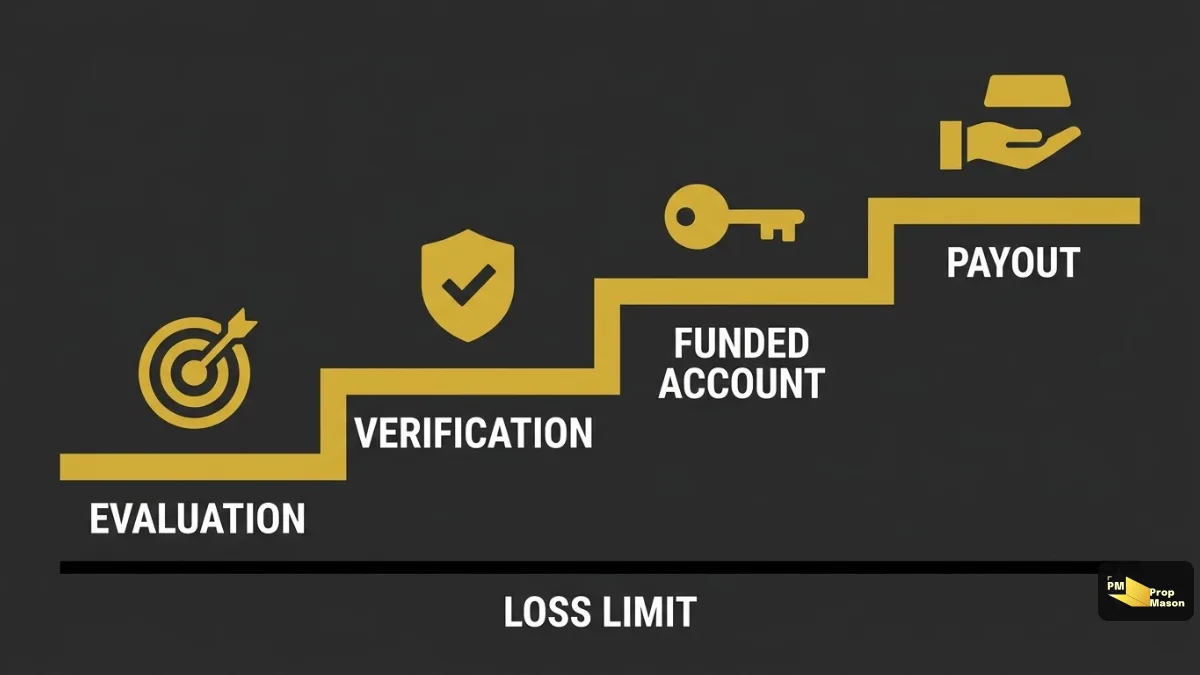
A practical process includes:
- Read the rulebook and checkout terms before paying.
- Convert daily loss and maximum drawdown into a real hard-fail number.
- Check whether drawdown is balance-based or equity-based, static or trailing, intraday or end-of-day.
- Confirm payout, refund, consistency, prohibited days, news rules, KYC, and restricted-country terms.
- Practice on demo or start with a smaller account before scaling up.
Two-step challenges usually test profitability twice before funded stage. One-step challenges shorten the path but may use stricter rules. Instant funding may reduce waiting time, but it does not remove loss limits, payout thresholds, consistency rules, or prohibited-strategy rules.
Drawdown Matters More Than Advertised Account Size
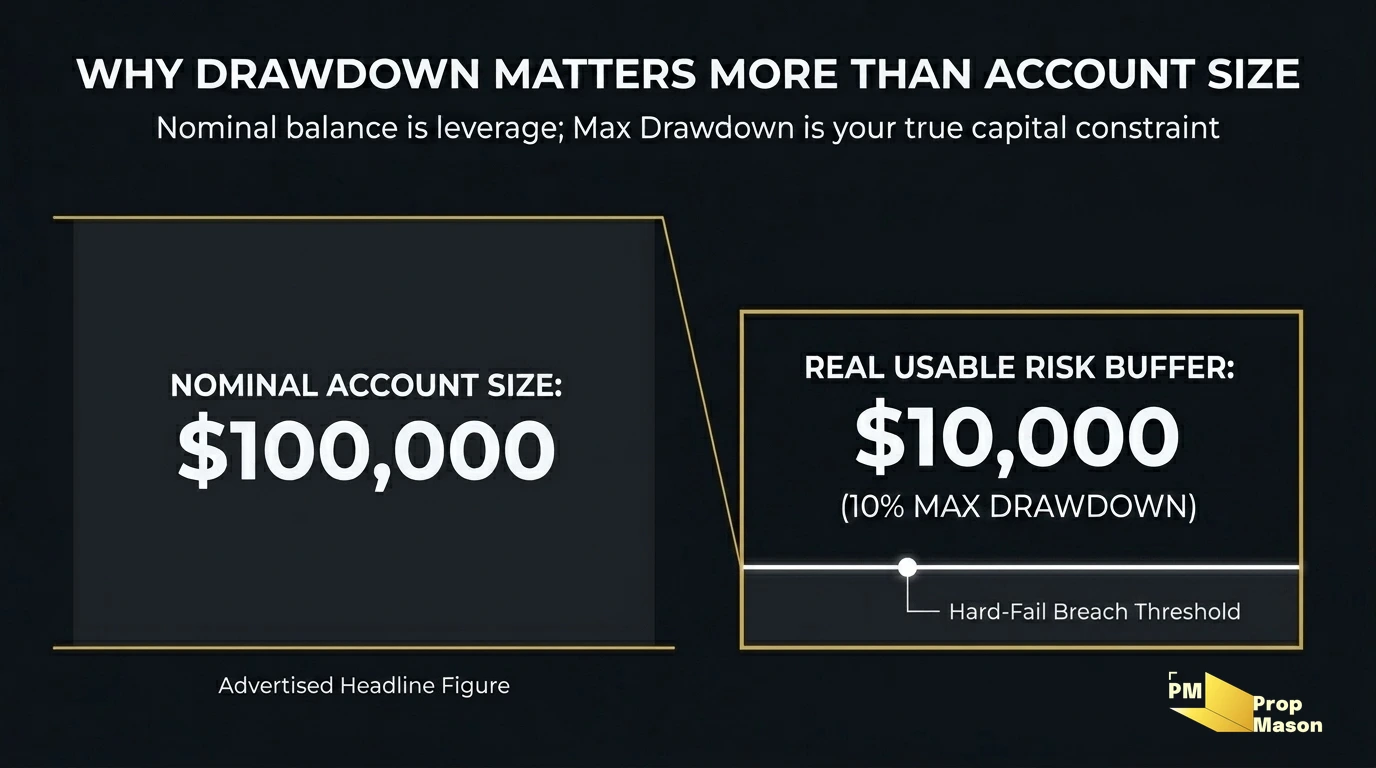
A large advertised account does not automatically mean a better opportunity. The real question is whether the drawdown buffer fits the strategy. A 100,000 USD account with a 10% maximum loss is very different from the same account size with a tight trailing drawdown or floating-profit updates.
Before paying, write down daily loss, maximum drawdown, risk per trade, and expected losing streak. If those numbers do not match the trading journal, a larger account can simply create larger psychological risk.
Profit Split, Payout, Refund, And Scaling Are Conditions
A high profit split does not guarantee fast money. Payout can depend on time, minimum profit, KYC, no open breach, strategy rules, consistency limits, and payment method. Challenge-fee refunds can also depend on specific terms and may occur only after a first valid payout.
Scaling plans matter only when the requirements are current and clearly written in official documentation. If cycle count, profit level, drawdown, or timing requirements change, the scaling plan changes too.
How To Choose A Prop Firm Educationally
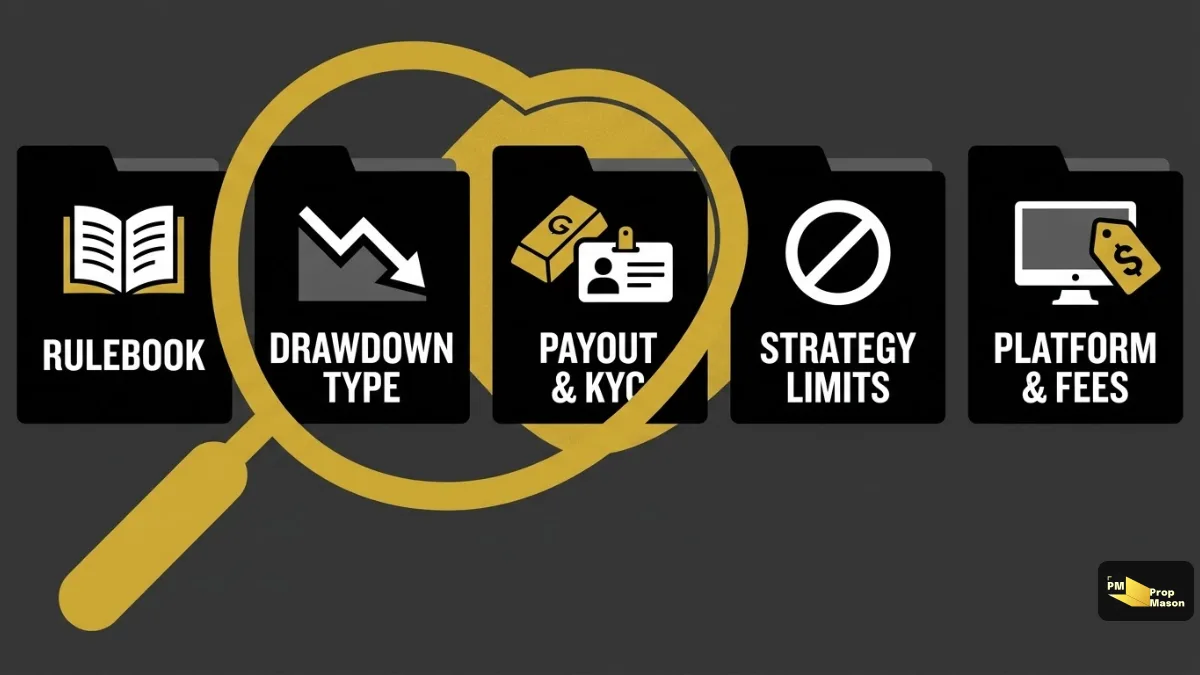
Use a checklist before comparing discounts:
| Item | Question to answer |
|---|---|
| Rulebook | Where are the current terms and when were they updated? |
| Drawdown | Static, trailing, EOD (end of day: the limit is recalculated once, at the close), or intraday? Balance or equity? |
| Payout | What are the cycle, minimum, KYC, and blocking conditions? |
| Refund | Is the fee refunded after passing or after first payout? |
| Market | Forex, CFD, futures, or crypto? |
| Platform | MT4, MT5, cTrader, Match-Trader, or futures platform? |
| Personal risk | Have tax, legal, restricted-country, and fee-budget issues been checked? |
Beginners should prioritize simple rules, smaller accounts, clear drawdown, and demo practice. Scalpers need to check spread, commission, slippage, and news rules. Swing traders should be cautious with trailing drawdown tied to floating profit. Futures traders should review contract limits, data fees, session hours, and daily loss tiers.
Legal, Tax, And Ethical Risks
Payouts from overseas firms may create recordkeeping, filing, or professional-advice needs depending on residence. This article is not legal or tax advice. Keep invoices, payout history, support emails, and the rulebook version used when trading.
Using another person's identity, buying or selling accounts, prohibited copy trading, latency arbitrage, or account management for others can block payout even when an account is profitable. Bots, EAs, and APIs should be used only when the rulebook clearly allows them.
Conclusion
Prop firm funding is worth considering only when the trader understands the rules before looking at account size, discounts, or profit split. Turn every marketing claim into a risk formula, payout condition, and official-source check. If the rulebook does not fit the trading journal, the cautious choice is not to buy or to start smaller.
FAQ
Is prop firm funding the same as a cash loan?
No. In prop trading, it usually means evaluation access or rule-based account access, not a bank loan or guaranteed capital.
Does maximum profit split mean I will receive that rate?
No. Profit split applies only to eligible profits under the rulebook. Actual payout can depend on KYC, timing, withdrawal rules, consistency, fees, and no terms breach.
How should beginners start?
Start by reading the rulebook, practicing on demo, keeping a trading journal, and choosing a smaller account if still interested. Do not buy only because a page advertises large account size or fast payout.
Is prop trading worth it in 2026?
Prop trading can be worth considering for disciplined traders who already have a profitable strategy and want access to larger account sizes without risking personal capital beyond the evaluation fee. However, evaluations enforce strict loss limits, and many add a daily cap or a trailing drawdown. It is only worth it if the specific firm's rulebook matches your trading style and risk tolerance.
How much can you make prop trading?
Potential earnings depend entirely on the account size, the profit split percentage, and your personal performance under the firm's risk limits. Prop firms do not guarantee profits, and no independent industry-wide earnings figures exist; check the firm's own page for its published payout terms and eligible profit rules.
Is prop trading legal?
Whether you can take part depends on your country and on each firm's own eligibility terms; this guide is not legal advice. Prop firms generally operate as proprietary trading or educational evaluation providers rather than retail deposit-taking brokers. Regulatory treatment, taxation, and geographic availability vary by country, so traders should verify local compliance rules and the firm's restricted-country list before signing up.
What is prop trading?
Prop trading means trading with a firm's money instead of your own. At retail prop firms you pay an evaluation fee, trade an account that is often simulated, follow strict loss limits, and get a share of profits only when the payout rules are met.
How do prop traders get paid?
Through a payout from the firm, paid as a share of eligible profit. On PropMason's firm pages (checked 6 October 2026), FTMO pays 80% on 2-Step accounts and 90% on 1-Step every 14 days, Topstep pays 90% with a $125 minimum, and Take Profit Trader's PRO account pays 80% on demand. Each payout follows the firm's own rules.
Do prop firms give you real money?
The account you trade is often simulated, but an approved payout is real money. Topstep, for example, calls its Express Funded Account a simulated funded-level account and says it "pays you real money based on your simulated trading results" (checked 6 October 2026).
Related Reading
- What is a prop firm?
- How to pass a prop firm challenge
- Prop firm drawdown rules
- Compare prop firms
- Scoring methodology
- Prop firm directory
Next step
Use PropMason as an educational checklist: read rules, compare drawdown, verify payout terms, and check official sources on the day you pay before deciding what prop trading is worth to you.