
Review how PropMason evaluates rules or browse the full directory of tracked prop firms.
Each row represents one crypto-offering evaluation program on a 100K account as the firm's website showed it between 9 October 2026 and 12 October 2026. Entry fees are each firm's list price; a running sale brings the checkout price down.
| Program | Entry fee | Max loss | How it moves | Daily loss | Profit split | Weekend holding |
|---|---|---|---|---|---|---|
| FTMO 1-Step | €499 (euros) | 10% / $10,000 | end-of-day trailing | 3% / $3,000 | 90% | see the firm's page |
| FTMO 2-Step | €540 (euros) | 10% / $10,000 | static | 5% / $5,000 | 80% | see the firm's page |
| FundedNext Stellar 2-Step | $549.99 | 10% / $10,000 | static | 5% / $5,000 | 80% | Allowed |
| FundedNext Stellar Lite | $399.99 | 8% / $8,000 | static | 4% / $4,000 | 80% | Allowed |
| Instant Funding One-Phase | $746 | 8% / $8,000 | static, per its rules page | 3% / $3,000 | 80% | Conditional |
| Instant Funding Two-Phase | $539 | 10% / $10,000 | see the firm's page | 5% / $5,000 | 80% | Conditional |
| Blue Guardian 2-Step Standard | $463 | 8% / $8,000 | see the firm's page | 4% / $4,000 | see the firm's page | see the firm's page |
| FundingPips 2-Step Pro | $466 | 6% / $6,000 | static | 3% / $3,000 | 80% | see the firm's page |
The rows are not a ranking. FTMO lists its fee in euros; the dollar amounts in this table assume an account held in US dollars. End-of-day trailing means the loss floor moves up only with your end-of-day balance. For cells that point to the firm's page, the firm's own pages gave different numbers or our data lacks the figure, so check it on the firm's page before you pay. The weekend holding column indicates general account permission, while instrument-specific rules for crypto trading appear in the sections below.
One bad crypto day against eight daily limits
A bad day in crypto costs the same dollar loss on any account, but the daily limit deciding whether you survive differs from program to program. When volatility hits an open trade, your daily loss allowance is what matters first.
Consider an account of 100K carrying a crypto trade whose notional value equals half the initial balance. This sizing is an example rather than a recommended allocation.
Suppose the coin falls by a tenth during a single trading day. That move generates an unrealized loss of $5,000, treating a one-tenth decline as an illustrative scenario rather than a forecast.
This single drop hits each program differently. For FTMO 2-Step ($5,000), FundedNext Stellar 2-Step ($5,000), and Instant Funding Two-Phase ($5,000), the loss reaches 100% of the daily threshold. It consumes the whole allowance. Whether reaching that limit exactly counts as an immediate breach depends on each firm's rule wording.
Across FundedNext Stellar Lite ($4,000) and Blue Guardian 2-Step Standard ($4,000), that same move reaches 125% of the limit. The account breaches under those firms' daily rules. Meanwhile, at FTMO 1-Step ($3,000), Instant Funding One-Phase ($3,000), and FundingPips 2-Step Pro ($3,000), the drawdown hits 166.67% of available daily room. FundingPips notes on its Get Started page that it does not accept traders resident in Iran, Vietnam, or the United Arab Emirates.
The daily limit decides whether a volatile day breaks an account long before the maximum loss cap comes into play, which reaches $10,000 on the roomiest programs. Learn how daily and max loss differ before picking a challenge.
What crypto means at each firm, in its own words
At every firm here, you trade simulated prices rather than holding coins in a wallet. What changes is the market those prices come from.
| Firm | What its page says about crypto | Where to read it |
|---|---|---|
| FTMO | Permits trading all available instruments on the platform, including crypto, inside a simulated CFD account | FTMO trading instruments |
| FundedNext | Describes crypto trading as simulated price contracts rather than real coin ownership across specified pairs | FundedNext crypto specifications |
| Instant Funding | Maintains dedicated crypto-titled programs while publishing separate leverage specifications for crypto across all models | Instant Funding trading rules |
| Blue Guardian | Platform rules list crypto as one of four markets, with crypto leverage of 1:2 | Blue Guardian platform specifications |
| FundingPips | Restricts crypto access to Bitcoin and Ether contracts among 41 total instruments, applying a maximum lot cap per trade order | FundingPips platform terms |
| E8 Markets | States that crypto sits inside forex products, dedicated products such as E8 One Perpetuals (perpetual futures contracts with no expiry date) carry more coins, and all accounts are demo with no CFD, spot, or futures execution | E8 Markets allowed instruments |
| The5ers | Includes crypto assets among tradable markets in its High Stakes evaluation challenge | The5ers High Stakes rules |
| Topstep | Offers no CFD crypto products, but permits trading CME Micro Bitcoin and Micro Ether futures contracts | Topstep permitted contracts |
Each provider establishes its own execution terms and liquidity simulation.
Holding over a weekend and trading over a weekend are different rules
Holding a trade through Friday settlement and trading over the weekend are two different rules on a prop firm account. A rule that lets you keep a trade open over the weekend does not mean the platform quotes prices on Saturday or Sunday.
FundedNext lets Stellar accounts hold over the weekend, but its help center says crypto pairs trade Monday to Friday only and Express Consistency (a FundedNext account type) accounts must close before the weekend. For Instant Funding, its trading rules page allows weekend holding during the challenge phases and does not list it for funded One-Phase or Two-Phase accounts. At FTMO, traders may execute orders whenever symbol pricing remains active, but funded Standard accounts must close trades before Friday settlement while Swing tiers remain unrestricted (Standard and Swing are FTMO account types; Swing allows weekend holding). For FundingPips 2-Step Pro, holding overnight and over the weekend is allowed during the evaluation; on the Master account (FundingPips' funded account), the system closes open trades unless you buy the Swing add-on.
Continuous price action on crypto exchanges does not give you continuous trading rights on a prop account. Account rules govern your positions, and terms often shift between evaluation and funded stages.
A crypto payout is not a crypto market
Firms use the word crypto for three separate things: the coins you trade, the account model, and how payouts reach you.
A prop firm can pay your profits in cryptocurrency without offering any crypto trading on its platform. Conversely, a firm can let you trade simulated Bitcoin while sending your payouts strictly through bank wires or payment processors. How a firm pays and what it lets you trade run on different rulebooks, explained on each firm's payout page.
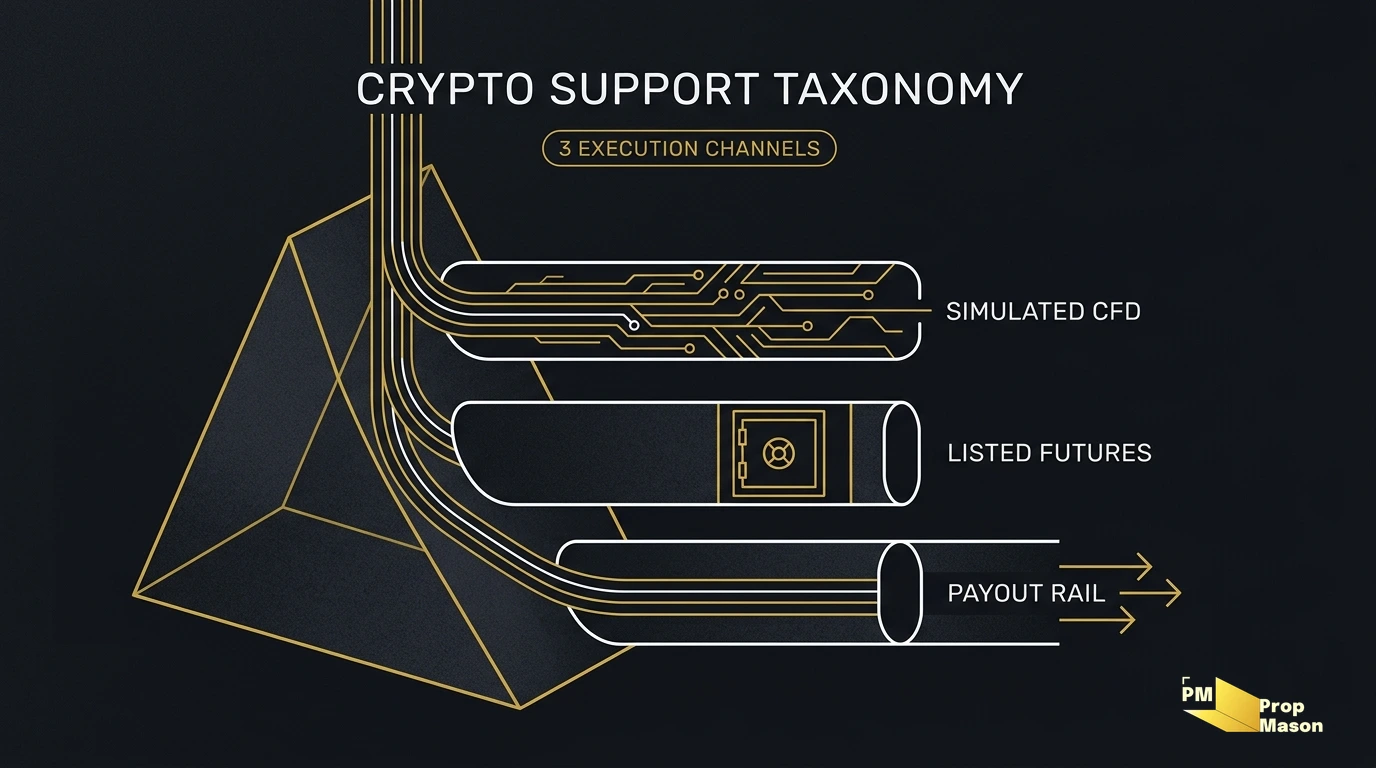
Traders should examine payout terms and market rules separately. Compare withdrawal methods and schedules in our payout rules guide.
Where the same coin behaves differently from one stage to the next
Rules you trade under during an evaluation do not always carry over to the funded account. Several firms tighten crypto terms the moment you pass.
FundingPips notes in its help center that crypto leverage drops when an account moves from evaluation to the funded Master account. Along with the weekend closes at FTMO and FundedNext noted above, these stage shifts mean rules from a challenge phase do not always apply once an account is funded.
Daily loss reset schedules also vary. Blue Guardian's rules page says the daily loss limit resets at 5:00 PM EST, so positions opened before that reset carry their floating risk into the next trading day. You must track drawdown against the server's reset clock rather than your local timezone.
If your plan is not a simulated CFD crypto account
Simulated CFD trading is only one way to trade crypto through a prop firm. Traders looking for futures contracts, currency-focused challenges, or instant funding can compare other models across our directory.
| Your trading plan | Where to look next |
|---|---|
| Trade cryptocurrency through regulated CME futures | Our comparison of futures prop firms |
| Specialize in currency markets with crypto on the side | A guide to forex prop firms |
| Minimize upfront challenge purchase expenses | Review cheapest prop firm accounts |
| Compare single-phase assessments against two-stage paths | Our breakdown of one-step versus two-step challenges |
| Contrast trailing equity floors with end-of-day calculations | Learn about trailing versus EOD drawdown |
| Skip assessment phases for immediate simulated funding | An overview of instant funding versus challenge accounts |
| Confirm eligibility from American jurisdictions | Coverage in our US trader prop firm guide |
| Browse all tracked prop firms | The complete prop firm directory |
Which of these programs fits how you trade crypto
Program choice comes down to your daily loss tolerance, your coin list, and whether you need to hold trades over the weekend.
Traders who open positions sized near half of account capital must check the daily loss allowance first. FundingPips 2-Step Pro provides a daily loss cushion of $3,000, while FTMO 2-Step allows $5,000 of daily room. Strategies requiring multi-day holds across Friday settlement must verify the specific weekend policies documented above, as certain programs enforce automated closures.
Symbol availability also creates a dividing line. FundingPips limits crypto trading to Bitcoin and Ether, while other firms document their own coin lists on their instrument pages. Traders seeking perpetual-futures price data rather than CFD spreads can inspect E8 Markets; its figures for that model are on E8's own pages. Profit splits also diverge: FTMO 1-Step provides a 90% split, while FTMO 2-Step awards 80% and FundedNext Stellar 2-Step offers 80%.
Related Reading
Read our prop firm comparison guides below to see how drawdown rules, challenge costs, and payout schedules compare across different trading firms.
- Futures prop firm rules: Contrast centralized CME futures execution against simulated CFD contracts.
- Forex evaluation programs: Compare multi-asset trading conditions and loss baselines across currency-first firms.
- Trailing versus EOD drawdown models: Understand how trailing and session-close drawdown formulas alter risk cushions.
- Instant funding versus evaluation challenges: Weigh higher upfront purchase fees against bypassing multi-step evaluation rules.
- Prop firm payout terms and cycles: Inspect payout schedules, withdrawal thresholds, and split arrangements across different firms.
- US trader evaluation access: Check country restrictions and jurisdictional availability for traders based in the United States.
Sources
Every rule, drawdown limit, and fee figure on this page comes directly from each firm's own public pages, read on the dates listed below.
- FTMO challenge specifications, read 12 October 2026.
- FTMO tradable instruments FAQ, read 12 October 2026.
- FTMO overnight and weekend rules, read 12 October 2026.
- FundedNext CFD programs portal, read 9 October 2026.
- FundedNext cryptocurrency FAQ, read 9 October 2026.
- FundedNext weekend holding terms, read 9 October 2026.
- Instant Funding evaluation pricing, read 13 October 2026.
- Instant Funding trading specifications, read 13 October 2026.
- Blue Guardian platform portal, read 15 October 2026.
- Blue Guardian platform rules, read 15 October 2026.
- FundingPips general terms, read 9 October 2026.
- FundingPips 2-Step Pro model, read 12 October 2026.
- E8 Markets allowed instruments, read 12 October 2026.
- The5ers High Stakes evaluation overview, read 9 October 2026.
- Topstep permitted trading products, read 9 October 2026.
- Commodity Futures Trading Commission (CFTC) education and advisories.
- National Futures Association (NFA) regulatory notices and investor resources.
Disclosure and risk
PropMason may earn commissions from some links; see the affiliate policy. Commercial relationships change neither the order of firms nor the wording about them on this page. Evaluation challenges involve fees and simulated-account rules; this article is research information, not financial, investment, legal or tax advice, and does not guarantee an execution or payout. Trading crypto, futures and forex carries a risk of loss. The CFTC and the NFA publish warnings and fraud advice for traders in the United States. Read how PropMason checks and edits its pages in the editorial policy.
FAQ
Which prop firm accepts crypto?
Multiple prop firms support crypto assets across distinct execution models. Providers offering simulated CFD contracts include FTMO, FundedNext, Instant Funding, Blue Guardian, and FundingPips. Other firms provide perpetual-futures market data or listed exchange futures. Firms built specifically for crypto also exist, and the directory lists HyroTrader as a crypto-only firm.
Can you trade crypto on a prop firm?
Traders can speculate on crypto price moves through simulated prop firm challenges using CFDs, perpetual-futures data feeds, or exchange-traded futures. CME Micro Bitcoin and Micro Ether contracts are available through futures providers such as Topstep. Because these accounts simulate trading rather than holding real coins, your risk lies in the firm's trading rules and its ability to pay, not in an exchange holding your tokens. The CFTC and the NFA publish regulatory warnings on derivative risks.
How much is a 10K prop firm account?
Pricing for a 10K challenge is €89 for FTMO 2-Step and €79 for FTMO 1-Step. FundedNext lists $59.99 for Stellar Lite, while Instant Funding charges $127 for One-Phase and $89 for Two-Phase. Blue Guardian lists $75 for its 2-Step Standard program. Entry fees scale with capital size, as shown in our 100K comparison table above.
What are the best crypto prop firms in the USA?
PropMason does not rank evaluation firms or publish best-firm declarations. For American traders, the first thing to check is each firm's country list, because some firms restrict access based on residency. Traders should inspect country eligibility lists on official firm websites and verify how daily loss formulas are calculated before purchasing an account. Review our US trader prop firm guide and our evaluation methodology for detailed jurisdictional guidance.
Next step
Before you pay for a challenge, test your planned trading strategy against the specific daily loss mechanics and weekend trading restrictions of your chosen firm. Select the program whose daily loss limit accommodates your average position sizing, open its official specifications to verify where daily drawdowns are measured from, and confirm whether cryptocurrency symbols permit weekend trading or holding. You can see where the account breaches across different balance levels using our drawdown rules guide.