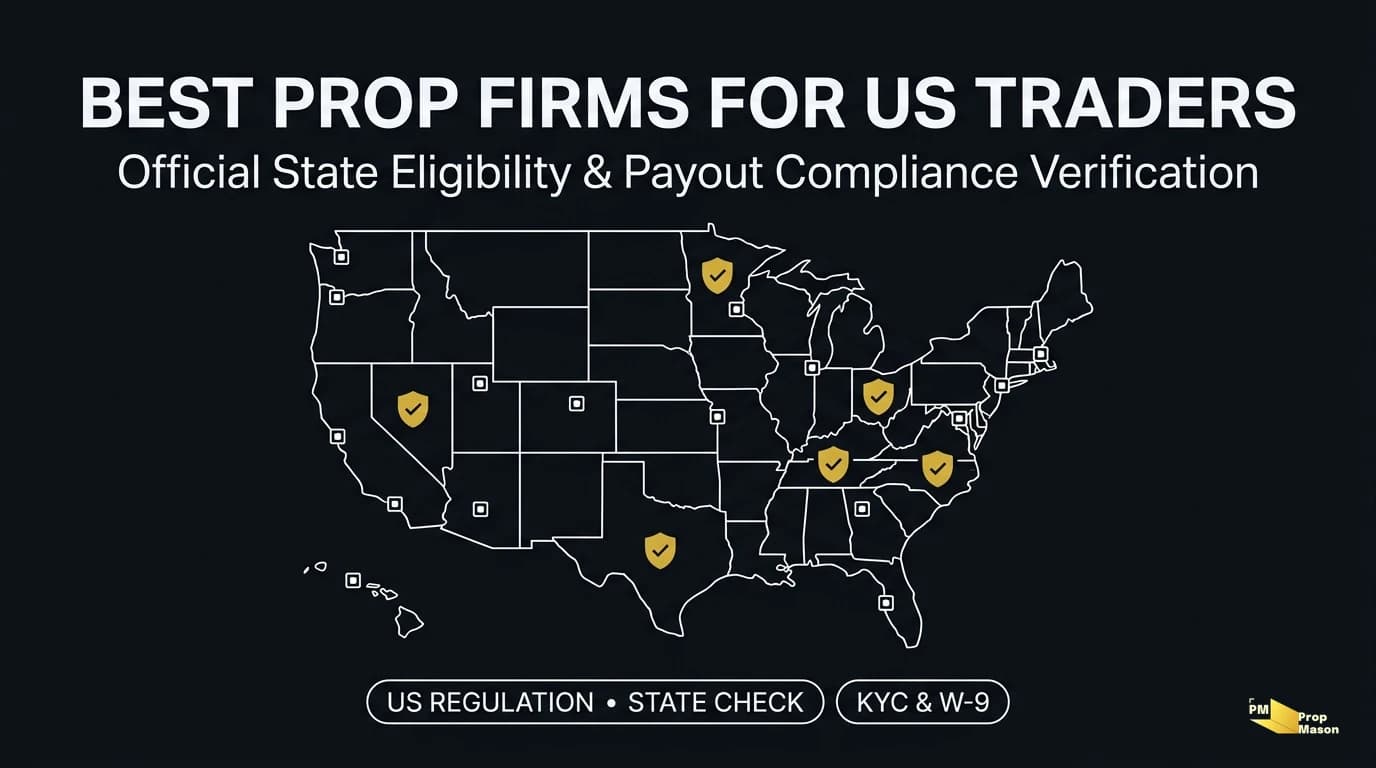
Where you live does the first sorting. A resident of South Carolina loses FTMO, which turns away residents of that state. Residents of Puerto Rico and Guam lose TradeDay, and also Rise, the payout company behind both TradeDay and Earn2Trade. In twelve states Rise lets you sign up but shows no payments at all.
The first table lines up each firm's 50K futures test. The maximum loss limit is how far the account can fall before the test fails. A limit that trails rises behind your best balance, and one measured at end of day moves only with the closing balance.
The profit target is the gain that passes the test, and the profit split is the share of profit you keep once funded. Prices come from the firms' own pages on 9 October 2026, before any discount code. Four of the six fees bill every month; FundedNext and The5ers charge no monthly fee.
| Firm and program | Entry fee | Max loss limit | How the limit moves | Profit target | Profit split |
|---|---|---|---|---|---|
| Topstep Trading Combine, Standard plan | billed monthly, on Topstep's plan page | $2,000 | trails, measured at end of day | $3,000 | 90% |
| TradeDay Fast Pass, end of day | $189 a month, list price on 13 October 2026 | $2,000 | trails, measured at end of day | $3,000 | 80% |
| Earn2Trade Trader Career Path | $190 a month on its non-US price page; a US buyer pays what the US checkout shows | $2,000 | trails, measured at end of day | $3,000 | 50% to 80% |
| Take Profit Trader test | $170 a month, then a one-time fee to open the funded account, listed on its home page | $2,000 | trails, measured at end of day | $3,000 | 80% |
| FundedNext Futures Rapid Pro | paid once; FundedNext's own pages show different prices for this test, so the one that counts is at its checkout | $2,000 | trails, measured at end of day | $3,000 | 90% |
| The5ers Futures Day Trade | $100, no monthly fee | listed on The5ers' futures page | measured at end of day | listed on the same page | 80% |
US-based futures firms come first, then the two global firms with futures programs. FTMO has no row. A US resident buys its futures tests on ftmo.com and its forex challenges from FTMO US at ftmo.oanda.com, which sets its own dollar prices, so FTMO's euro prices for the rest of the world do not apply. FundedNext also sells forex accounts to US clients from a US price list that differs from its global one, so no FundedNext forex price appears here. Earn2Trade's US Trader Career Path page shows the same loss limit and target as its non-US page.
Every fee in that table buys an evaluation, and the "funded" account that follows is in most cases simulated too. FTMO US says its funded traders "trade with simulated capital only", Earn2Trade's first funded stage is a LiveSim account that trades "simulated capital using real-time market data", and TradeDay calls its first funded stage Funded Sim.
A payout is the firm sending your share of that simulated profit to your bank. Take Profit Trader's FAQ says that once you withdraw, "the profits paid to you are absolutely real", and each firm pays under its own terms.
What each prop firm's own page says about US residents
Going by their own pages, all seven firms sell to US residents, and FTMO does it in two places: futures on ftmo.com and forex through FTMO US. None of them takes every American on the same terms. The limits sit in three places: who counts as a resident, which states and territories a firm or its payout company leaves out, and the route the money takes to a bank.
| Firm | Who the page accepts | What is closed to US residents | Payout route to a US bank |
|---|---|---|---|
| Topstep | Decided by "both citizenship and permanent residency"; "No US citizenship required" | No US state or territory named | Aeropay, a pay-by-bank link for US traders; ACH (the US network for bank-to-bank transfers) and wire also listed |
| TradeDay | Adults who are not a citizen or resident of a country on its prohibited list, which comes from its US clearing firm (the company that settles its futures trades) and its broker | Guam and Puerto Rico are on that list; the broker, the clearing firm and Riseworks run identity checks once you are funded | Riseworks, the payout company also known as Rise, after onboarding |
| Earn2Trade | US traders through its US pages, run by a Wyoming company | Rise, its payout company, does not serve Guam, Puerto Rico or the US Virgin Islands and shows no payments in twelve states | Rise |
| Take Profit Trader | US traders, from a Florida company | No US state named | Plaid (a service that links your bank), Wise or PayPal, all in the trader's own name |
| The5ers | Anyone over 18; the United States is not on its list of countries it cannot accept, for forex or futures | No US state or territory named | Its join pages do not name one |
| FundedNext | US residents, for its futures and forex challenges, by its US clients page | MetaTrader (MT4, MT5) and expert advisors, the automated trading programs, on forex accounts; no new cTrader accounts | Its US client guide does not name one |
| FTMO Futures, sold on ftmo.com | US residents, judged "on residency, not on nationality"; individuals only, no companies; Guam, Puerto Rico and the other territories count as US | Residents of Arkansas, Delaware, Louisiana, Montana and South Carolina | A fully licensed US bank account in your name; Wise and Chime refused; a US tax ID and a W-9, the IRS form a US person gives whoever pays them, before the first payout |
| FTMO US, forex challenges | Legal US residents, or a company incorporated in the US; the territories count as US here too | "we do not currently accept entities from Arkansas, Delaware, Louisiana, Montana, or South Carolina" (entities: a legal word that covers companies) | A fully licensed bank only; Wise and Chime refused; a US Tax Identification Number before any reward |
The two FTMO pages name the same five states in different words. On its own, FTMO US's "entities" line could mean companies only, because the same page lists "individuals and entities" as two groups when it describes other refusals. The futures FAQ leaves no gap: it does not accept residents of those states. So a person living in one of the five has no FTMO futures route, and FTMO US's wording gives no reason to expect a friendlier answer on the forex side.
Futures or forex from the US: the platform narrows the list
A futures trader in the US has a route at all seven firms, because each sells a futures program to US residents. A forex trader has fewer, and the limit comes from each firm's own platform deal, not from one rule for the whole market. FundedNext's US guide says "MetaQuotes services are not available to clients located in the United States" (MetaQuotes is the company behind MetaTrader), so its US forex accounts run without MetaTrader, yet FTMO US offers MetaTrader 5 to the same people.
Trade futures, and the choice is about rules rather than access. Topstep, TradeDay, Earn2Trade and Take Profit Trader sell futures tests only, while FundedNext, The5ers and FTMO run futures programs beside their forex ones. FundedNext's futures accounts work on NinjaTrader, Tradovate and TradingView, its US page says.
Trade forex, and three firms on this page are left: FTMO US, FundedNext and The5ers. FundedNext and The5ers call their forex accounts CFD accounts; a CFD, or contract for difference, pays on a price move without you owning the currency. FTMO US's challenges trade simulated forex pairs plus US indices, gold, crude oil and bitcoin.
FTMO US is the widest of the three. Its platform page offers "MetaTrader 5 or TradingView", and its strategy page says it "generally" does not restrict "algorithmic trading, Expert Advisors, etc." The same page warns that a third-party EA, which other traders may be running too, can cost you the FTMO Rewards Account under its capital-allocation rule.
FundedNext sells its US forex challenges on Match-Trader only, a platform separate from MetaTrader, with no expert advisors and no switching platforms later; it stopped opening new cTrader accounts for US clients on 31 March 2026. The5ers' platform page says "US-based clients can use TradingView", through its web terminal, so TradingView is the platform it shares with FTMO US. The forex comparison covers CFD programs more widely.
Same loss limit, different floor rules
At the 50K size, five of these tests stop you at the same maximum loss and ask for the same profit target. They part on when the floor moves, and they agree on one thing wherever their rules spell it out: a loss you are still holding counts the moment it touches the floor.
TradeDay shows the first difference inside one firm. Its Quick Pay test comes with the same $2,000 limit in two versions. On the intraday one, TradeDay's help page says, the limit is "calculated on unrealized profits within the trading day, in real-time"; on the end-of-day one it moves only on the closing balance. The intraday version was $131 a month against $175 for end of day, both list prices on 13 October 2026.
The cheaper version is the harder test. Say a trade runs well into profit and then comes back to where you entered. Under the intraday trail the floor climbed with the open profit and stays up, so you finish flat with less room than you started with. Under the end-of-day limit the same round trip leaves the floor where it was. TradeDay's plan page also shows that the end-of-day Quick Pay account switches to an intraday trail once you are funded. The academy page on how the loss limit moves covers both kinds in more depth.
"End of day" describes when the floor moves, not when it is checked. Equity, your balance plus or minus what your open trades are showing, is what the four firms that spell this out watch all session. TradeDay says equity must stay above the floor "at any point during the day"; at Take Profit Trader an account that reaches its minimum balance "at any time" is liquidated; Earn2Trade counts open losses during the day, and FundedNext breaches a Rapid Pro account "instantly" on a floating loss past the limit. A losing trade that touches the floor at noon ends the test at all four, even if it would have recovered by the close.
Both Earn2Trade tests, the Trader Career Path and the cheaper Gauntlet Mini, use this end-of-day limit at the test stage; only its live funded account trails during the day.
Take Profit Trader changed its minimum number of trading days on 17 August 2026: new test accounts now need 3 trading days, plus its 50% profit consistency rule. A consistency rule caps the share of your total profit that your best day may supply. At Take Profit Trader, by its Rule 5, the best day must stay below that share of total net profit; going over does not fail the test, it raises the profit you need before you pass. A test that was already running before 17 August, or a reset of one (buying the same test again from the start, for a fee), keeps the longer minimum it was sold with.
Earn2Trade's rules page sets no minimum, but its own consistency rule means "a trader will need at least four profitable trading days". For TradeDay's Fast Pass, the minimum is the one printed on its plan card; its help page words the rule differently.
What one bad day leaves before the account fails
At Take Profit Trader the floor is the only stop on a bad day. Its test has no daily loss limit, so a single session can use up the whole maximum loss of a 50K account.
The test starts with a $2,000 maximum loss, which puts the floor at $48,000 on day one. The six test rules on the firm's help center name no daily limit, and the blog post that announced the shorter minimum lists the same rules with none. A first session that loses $2,000, closed or still open, reaches the floor, and Rule 3, "Do Not Hit End-Of-Day (EOD) Maximum Trailing Drawdown", ends the test. The firm leaves any personal stop to the trader.
Earn2Trade works the other way. Its evaluation rules list "Do not reach or dip below the daily loss limit" as a fail rule for both its tests, and any failure needs a reset before you can carry on. On the Trader Career Path that limit is $1,100, so a bad day ends the test well before the maximum loss is used up.
Topstep sits between the two. Its help article makes the daily loss limit optional in the Trading Combine, Topstep's test, and in the Express Funded Account, the account you trade after passing. A limit chosen at checkout, the page where you pay for the test, is fixed for that account.
Skip it there, and Risk Settings, the risk page in your Topstep account, still lets you set a personal limit that you are free to change or remove. Hitting the checkout limit is "not a rule violation": open positions are closed, trading stops until the next session, and the account stays eligible for funding.
| Test | Max loss | Daily loss limit | What a very bad day does |
|---|---|---|---|
| Take Profit Trader | $2,000 | none in its test rules | touching the floor, even with a trade still open, ends the test |
| Earn2Trade Trader Career Path | $2,000 | $1,100, a fail rule | reaching the daily limit fails the test and a reset is needed |
| Topstep Trading Combine, Standard plan | $2,000 | optional, fixed at checkout or set later as a personal limit | with the checkout limit on, trading pauses for the session and the account carries on |
The three tests share a maximum loss and still end a bad day in three different ways. A trader who wants a hard daily stop gets one built in at Earn2Trade, gets one at Topstep only by choosing it, and at Take Profit Trader has to set it themselves.
How the money reaches a US bank, and what stops it
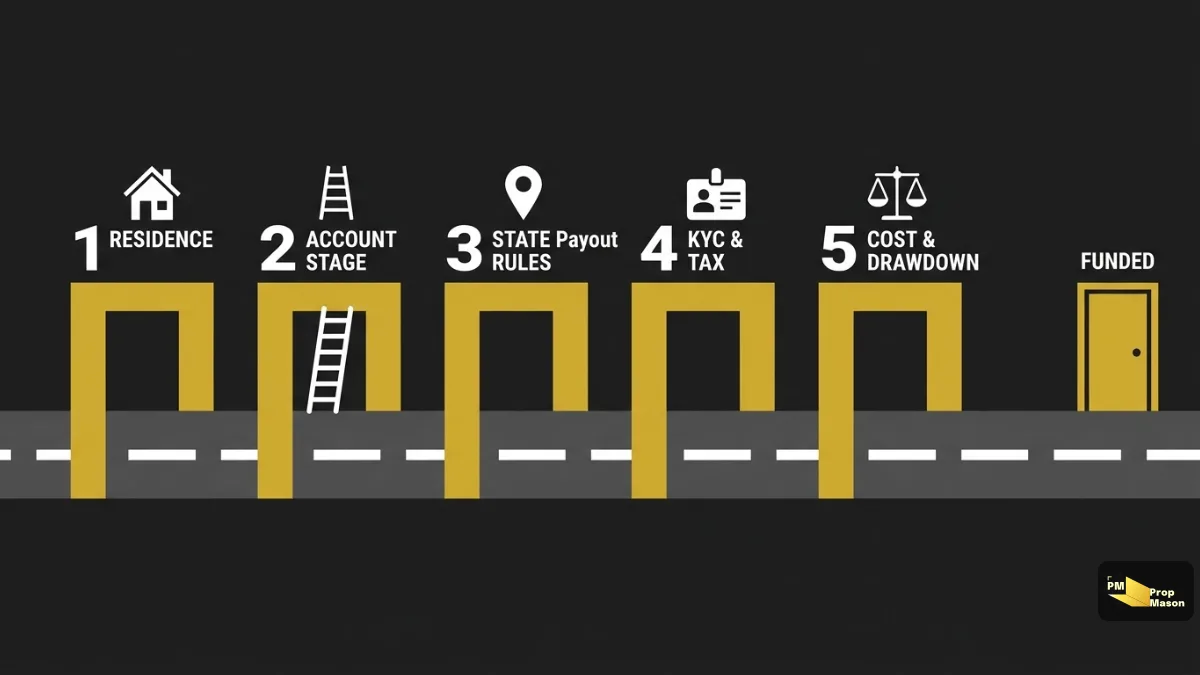
A payout reaches a US bank only when three things line up: an account in your own name of a type the firm accepts, a state or territory that the firm and its payout company both serve, and the tax number the firm asks for. The firms that publish a payout route also publish what they refuse, so each of the three can be checked before you buy the test.
A bank account in someone else's name is the first one. Take Profit Trader links your bank through Plaid, and Plaid connects only an account owned by the registered trader, so a payout to a spouse's or a friend's account does not go out. The same help page applies the rule to Wise and PayPal, where a name that does not match means the payout "will be delayed for manual review or denied". An LLC, a limited liability company, is paid through Wise, or through PayPal if the LLC already has a PayPal account.
FTMO is stricter about the type of bank, for futures and at FTMO US alike. FTMO US and FTMO Futures pay only to a fully licensed bank and name Wise and Chime among the fintech and digital-only accounts they refuse. Neither releases a payout until you have given a valid US Tax Identification Number.
Where you live can stop a payout as well, and two firms here share one payout company. TradeDay pays through Riseworks and Earn2Trade through Rise, two names for the same company. Rise's availability page, dated 1 September 2026, lists Guam, Puerto Rico and the US Virgin Islands among the places it cannot serve. Its table of US states lets you sign up everywhere but marks both bank (fiat) and crypto payments as unsupported in twelve: Alaska, Georgia, Idaho, Indiana, Maine, Mississippi, New Jersey, Oklahoma, Tennessee, Utah, Vermont and Washington.
That table applies to TradeDay and Earn2Trade payouts alike. Earn2Trade's own notice, dated 3 January 2025, named an older list of places and promised traders there another payout route without saying which; it does not say whether that promise covers the states on Rise's current table, so that is a question for Earn2Trade or TradeDay support before you pay. A funded TradeDay trader also receives nothing until the Riseworks onboarding, with its own identity check, is complete, and TradeDay refuses residents of Guam and Puerto Rico outright, by its prohibited-countries page.
Topstep's payout policy set its smallest payout at $125 on 8 October 2026. Its Aeropay and ACH options pay US bank accounts only, and ACH and wire carry a processing charge. PropMason's payout rules page explains the conditions firms attach to a payout request.
W-9 or W-8BEN: citizenship and residence are different questions
Form W-9 belongs to a US person, which for an individual means a US citizen or a US resident for tax purposes. Form W-8BEN belongs to a nonresident alien who is the beneficial owner of the income. That is how the IRS instructions frame the two forms (W-9 instructions, W-8BEN instructions), and neither one is chosen by your address alone.
The firms put it in their own words. Topstep's tax page sets the form by situation: a W-9 for a US citizen anywhere in the world, a W-9 for a resident alien with an ITIN, and a W-8BEN for a non-US citizen living outside the US. A resident alien is a non-citizen the IRS treats as a US resident for tax, which includes a green-card holder. An ITIN is the IRS tax number for people who cannot get a Social Security number.
Take Profit Trader's help page sets the form by status: a W-9 for a US resident, a US citizen or a US-registered company, a W-8BEN for anyone who is not a US resident or company. FTMO asks for a W-9 at the first payout, on futures and at FTMO US.
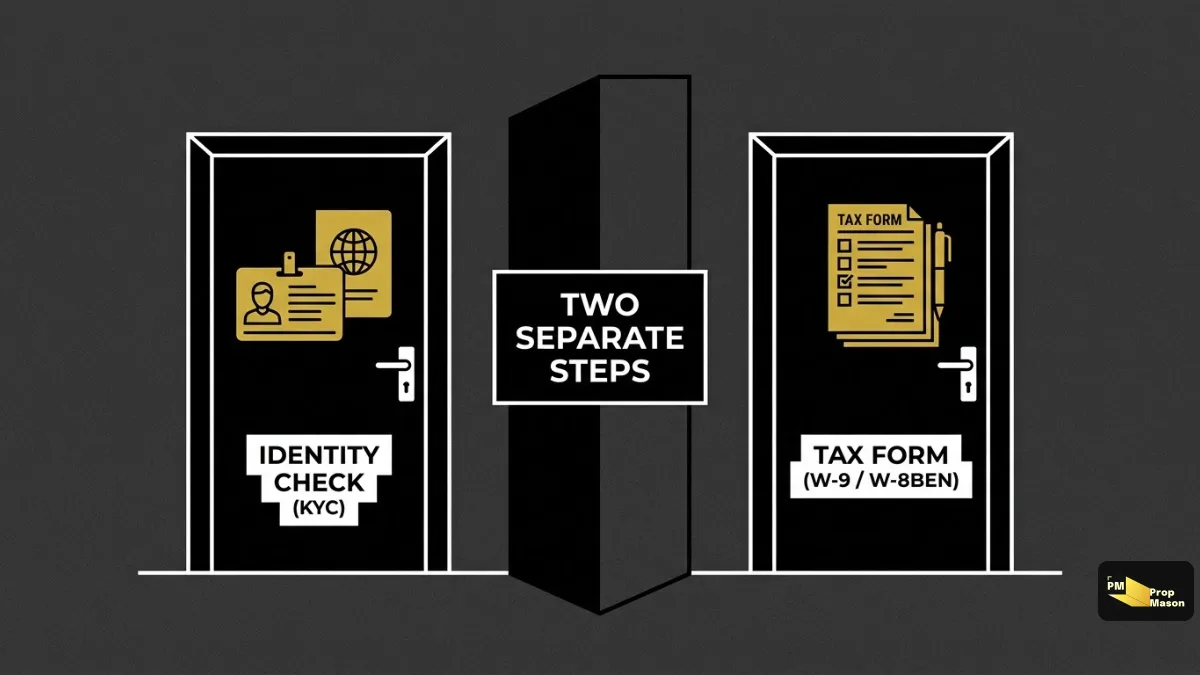
The distinction shows in two traders. A US citizen living in Portugal is still a US person and is asked for a W-9, even though no US state is home; Topstep's table says so in as many words. A foreign national spending a short stint in Texas may be a nonresident alien for tax purposes, and then the form follows that status, not the Texas address. The firm applies the form to your status, and a borderline case is one for a tax adviser who knows your situation.
If your state, platform or bank rules you out
A closed row in the access table is not the end of the search, but no page can promise that another firm will take you. The rows below point to where the next check is fastest, depending on what ruled you out.
| Your situation | Where to look next |
|---|---|
| You live in South Carolina | FTMO's futures FAQ turns away the state's residents and FTMO US names it in its "entities" line; Topstep and Take Profit Trader name no state, and Rise's current table shows payments working there |
| You live in Puerto Rico or Guam | TradeDay's prohibited list names both and Rise serves neither; FTMO counts both as part of the United States for futures and at FTMO US, and Topstep names no territory |
| You live in one of the twelve states where Rise shows no payments | TradeDay and Earn2Trade pay through Rise, so ask each which route you would get; Topstep, Take Profit Trader and FTMO name payout routes that do not run through Rise |
| You trade forex with an expert advisor | FundedNext's US forex accounts forbid them; FTMO US generally allows them on MetaTrader 5 |
| Your only account is at Wise or Chime | FTMO refuses both, for futures and at FTMO US; Take Profit Trader pays to Wise when the account is in your own name |
FAQ
What prop firms allow US citizens?
Citizenship and residence are separate tests, and the firms weigh them differently. Topstep's eligibility page looks at both and says US citizenship is not required. TradeDay turns away a citizen or a resident of a country on its prohibited list, so either tie can block you, even for someone who lives in a permitted country. FTMO goes the other way for futures: it judges US clients on where they live, not on their passport. FTMO US serves residents of the US too, which leaves out a US citizen who lives abroad.
Can you use prop firms in the US?
Yes, inside the state and platform limits each firm sets, and where you connect from can matter as much as where you live. FundedNext's restricted-countries page says clients on a MetaQuotes server cannot use a US-based IP address; a first breach brings a warning, and after that the account is terminated with no reward and no refund. The rule follows the connection, so a visitor logging in from the US is caught too.
Are prop firms legal in the USA?
What a prop firm sells a US customer is a simulated evaluation from a private company, not a brokerage account: you pay a fee, trade a simulated account under the firm's rules, and the firm decides payouts under its own terms. Orders reach an exchange only at a live stage some firms add later; Take Profit Trader says its live PRO+ accounts send orders through the broker Tradovate. TradeDay's footer carries the CFTC Rule 4.41 notice on hypothetical and simulated results (tradeday.com). For how US rules treat these products and your own case, the CFTC and the NFA publish guidance and take complaints.
How much does a $50,000 funded account cost?
A monthly bill adds up for as long as the test runs. At list price, TradeDay's Fast Pass is $189 a month and Take Profit Trader's test is $170 a month, putting TradeDay $19 higher for each month you stay in the test. Passing adds a one-time fee at Take Profit Trader to open the funded PRO account (our data has no amount for it), while TradeDay's Fast Pass card lists no activation fee. Topstep rebills monthly too. On its Standard plan a one-time activation fee follows the pass, and Topstep also sells a No Activation Fee plan without it. The5ers sold its Day Trade test for $100 on 12 October 2026, and its futures page promises "no monthly fees".
Which prop firms actually pay out?
PropMason keeps no count of payouts made, so no firm here is ranked on how often it pays. What the firms do publish is the bar a funded account has to clear before a request is accepted. Topstep makes you pick one of two payout paths after passing: Standard, which asks for a set number of winning days, or Consistency, which caps how much of your profit a single trading session may supply. FTMO US's reward page says no minimum profit is needed beyond the payment fees, then sets a small minimum closed profit to cover a bank wire. Topstep's smallest payout is $125, so a small first win clears FTMO US's bar before it clears Topstep's.
What is the #1 prop firm?
No firm comes first for every US trader, because a firm that fails your state, platform or bank check is out before its rules matter. PropMason's directory orders the firms by a published method, and nothing on this page changes that order.
Related reading
The access check settles which firms will sell to you; these pages help with the choice that comes after it, from price to passing the test.
- Cheapest prop firm tests
- Topstep and Earn2Trade compared
- Passing a funded-account evaluation
- Every firm PropMason tracks
Next step
Start from the access table, not the price table. Strike out each row that fails for where you live, how you trade or where you bank: for most US residents that removes one or two firms, and in South Carolina, Puerto Rico, Guam or one of Rise's twelve states it removes more. Price only what is left. For the futures firms among them, PropMason's futures firm table puts the kind of loss limit, the profit split and the entry cost in one row per firm.
Sources
- Topstep: Am I eligible to trade with Topstep?, page dated 4 September 2026.
- Topstep payout policy; Topstep: daily loss limit in the Trading Combine and Express Funded Account, page dated 30 June 2026; Topstep: funded trader tax questions, page dated 29 May 2026; Topstep plans.
- TradeDay: Can anyone join TradeDay?, page dated 21 July 2025, and TradeDay prohibited countries, modified 1 October.
- TradeDay: what is Fast Pass?, modified 9 September; TradeDay: the maximum drawdown rule and end-of-day against intraday drawdown, both modified 31 May; TradeDay plan cards and Rule 4.41 notice.
- TradeDay terms and conditions, page dated 11 August 2026.
- Earn2Trade: payout update for traders in certain US states and territories, page dated 3 January 2025, and Rise geographic availability, page dated 1 September 2026.
- Earn2Trade evaluation rules, page dated 6 July 2026; Earn2Trade drawdown types, page dated 10 August 2026; Earn2Trade: citizens who cannot get funded, page dated 7 March 2025; the Gauntlet Mini and Trader Career Path pages.
- Take Profit Trader test rules, Rule 3 on the end-of-day trailing drawdown, dated 13 November 2025, Rule 5 on consistency, its post on the shorter minimum, dated 17 August 2026, and its home page with the PRO account fee and FAQ.
- Take Profit Trader: connecting US bank accounts for payouts, dated 25 November 2025, and filling out tax forms.
- The5ers: who can join, page dated 23 June 2026; who can join The5ers Futures, page dated 15 July 2026; which trading platform The5ers uses, page dated 22 July 2026; The5ers futures programs.
- FundedNext: does FundedNext accept US clients?, page dated 5 May 2026; USA client guide, page dated 16 June 2026; restricted countries for CFDs, page dated 27 August 2026; restricted countries for futures and Rapid Pro challenge rules, both pages dated 30 September 2026; FundedNext futures challenges, one-time fee.
- FTMO Futures: who can join, no date shown on the page, and FTMO Futures overview.
- FTMO US: who can join, the trader eligibility page that names the five states, platforms, page dated 4 October 2026, instruments and strategies and withdrawing a reward.
- IRS instructions for Form W-9 and IRS instructions for Form W-8BEN.
Disclosure and risk
PropMason may earn commissions from some links; see the affiliate policy. Commercial relationships do not change the order of firms or the wording about them on this page.
This page is not financial, investment, legal or tax advice.
Trading futures and forex carries a risk of loss. The CFTC and the NFA publish warnings and fraud advice for traders in the United States.
Read how PropMason checks and edits its pages in the editorial policy.