Quick answer
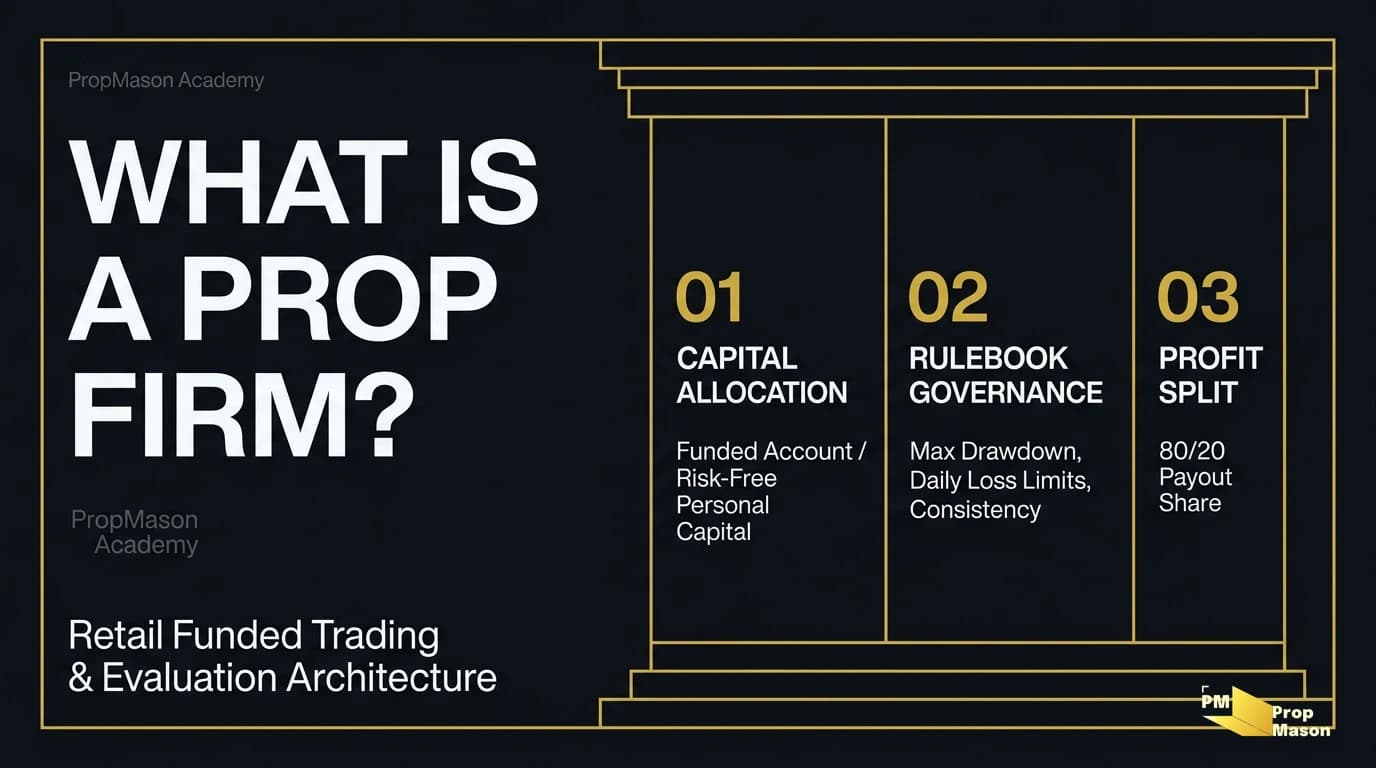
In retail funded trading, a prop firm usually offers an evaluation or funded account governed by its own rulebook. The trader pays to enter a challenge (firms use the terms evaluation and challenge interchangeably), trades inside risk limits, and may request payout only if the firm's conditions are met.
Funded accounts at many firms are simulated, while approved payouts are paid in real money. For instance, official rules at FTMO describe trading with Initial Simulated Capital under its evaluation program.
A large account size does not mean the trader receives that amount in cash. Being funded also does not guarantee payout. Each firm can define daily loss, maximum drawdown, consistency, KYC, payout cycle, and restricted strategies differently.
| Question | Short answer |
|---|---|
| What you pay | An evaluation fee, sometimes monthly; resets and activation can cost extra |
| What you trade | An account under the firm's loss limits, often simulated |
| What ends the account | Breaking the daily or maximum loss limit, or using a banned strategy |
| When you get paid | Only after the payout rules, KYC and any review are met |
| What account size means | A number the firm uses for its rules, not cash you own |
What to review before buying a challenge
Check each item on the firm's own pages for the exact program you plan to buy. If one is missing, ask support and save the reply.
- Account size, challenge fee, reset fee, and refund policy.
- Profit target, daily loss, maximum loss, and drawdown calculation.
- Minimum trading days, consistency rule, and breach conditions.
- First payout, payout cycle, minimum payout, fees, and KYC.
- Restricted strategies such as latency, arbitrage, copy trading, or news trading.
- Supported countries, payment providers, and legal terms.
- Official source, update date, and your access date.
How a prop firm differs from a broker account
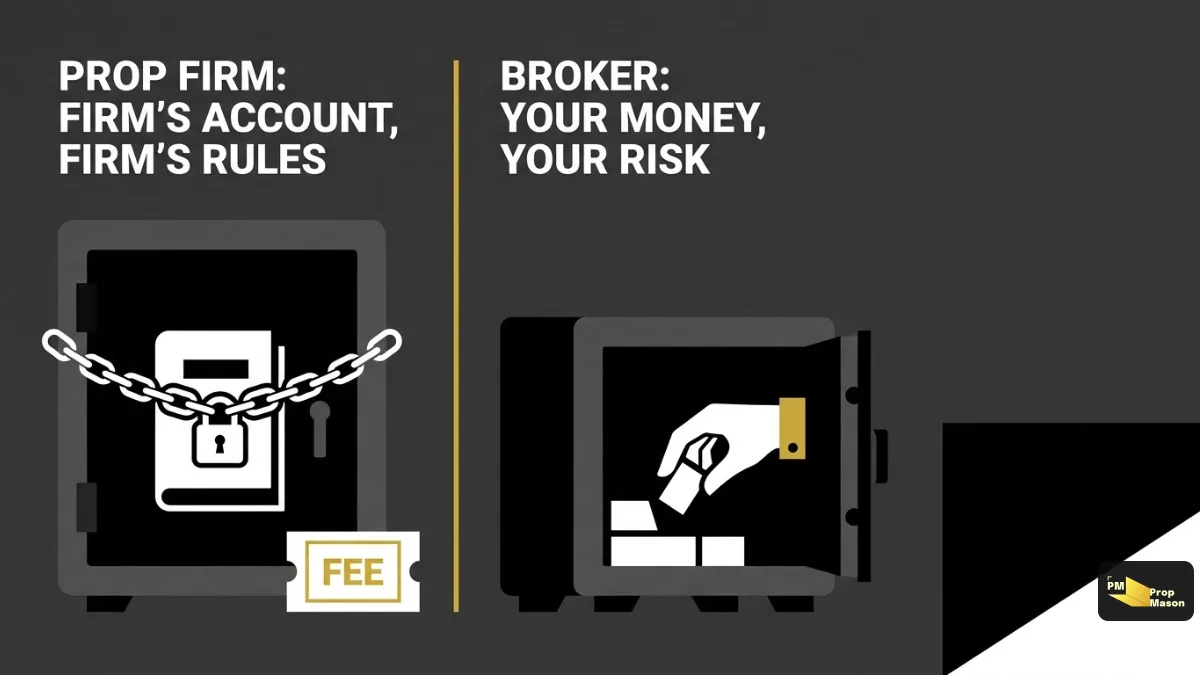
With a personal broker account, a trader usually deposits their own capital and takes direct account risk. With a retail prop firm, the trader usually buys access to an evaluation or funded-account program under the firm's rulebook.
That means spread, platform, and headline account size are not enough. Traders need to review risk rules, payout terms, KYC, strategy restrictions, and conditions that can close the account.
How do prop firms make money?
Prop firms generate revenue through evaluation fees, profit splits, and technology or data fees. As our guide on A-book vs B-book prop firms explains, A-book means orders are passed to an outside market and B-book means the firm keeps the risk; few firms say which one they use.
How this fits the Academy learning path
Start here if you are new to prop firms. After understanding what a prop firm is, read How Prop Firm Evaluations Work to understand the challenge flow.
Then review Prop Firm Drawdown Rules, Prop Firm Payout Rules, and A-book vs B-book Prop Firms for practical risk context.
Why account size is not enough
A 100K account can sound attractive, but the trader does not directly own that amount. Account size is simply the framework or a number the firm uses for its rules, targets, and payout calculations.
If daily loss is tight, payout review is unclear, or KYC does not support your country, a large account size may not be suitable. Compare practical conditions instead of only marketing headlines.
Common mistakes
The first mistake is treating a prop firm as a shortcut to guaranteed capital. No challenge guarantees passing, funding, payout, or profit.
The second mistake is skipping the rulebook. Many problems come from drawdown, consistency, strategy restrictions, KYC, or payout terms rather than the profit target.
The third mistake is using community reviews instead of official sources. Reviews can help you ask questions, but decisions should rely on the newest rulebook, terms, payout page, and support documents.
Official-source checklist
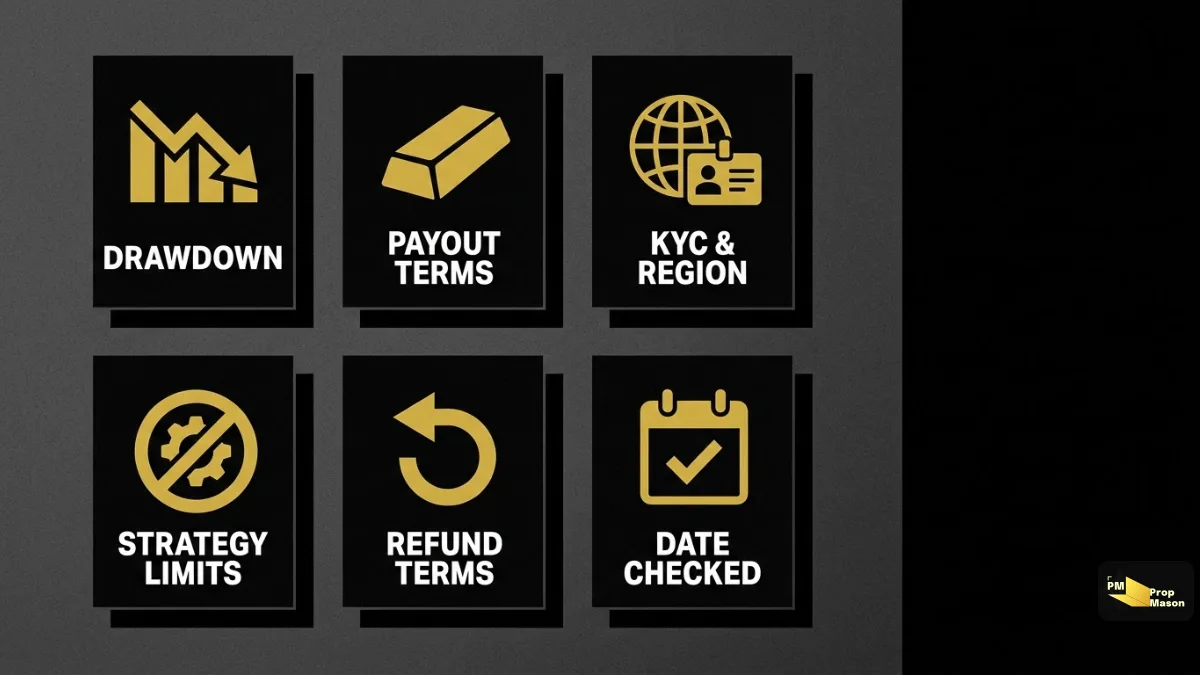
Use these questions when you read a firm's rulebook, payout page and terms, and save the page date with each answer.
- Does the rulebook explain breach conditions clearly?
- Does the payout page show first payout, cycle, minimum, and fees?
- Does KYC fit your country, documents, and payment route?
- Do strategy restrictions affect your trading style?
- Do terms explain refunds, disputes, data use, and account closure?
- Have you saved the access date and rulebook version?
Related Reading
Read next: What Is Prop Trading, How Prop Firm Evaluations Work, Prop Firm Drawdown Rules, Prop Firm Payout Rules, A-book vs B-book Prop Firms, Prop Firm Directory, and How We Verify Firm Integrity.
Sources and methodology
This guide relies on each firm's own rulebooks and help pages, read on the dates shown below.
- This guide prioritizes official materials: rulebooks, pricing pages, payout pages, KYC terms, legal terms, and support documents from each firm.
- Because terms can change, traders should verify official sources on the day they make a decision.
- Evidence hierarchy: official documents first; community reviews are context or verification questions only.
- This content is educational, not financial, legal, tax, or investment advice, and it does not guarantee passing, funding, payout, or profit.
- Funded Trading Plus KYC verification process: the firm calls its funded accounts simulated live and requires KYC before any withdrawal, checked 6 October 2026.
- Funded Trading Plus risk review policy: withdrawal requests from simulated live accounts trigger a risk review, checked 6 October 2026.
Trading futures and forex carries a risk of loss. In the United States, the CFTC and the NFA publish fraud warnings and guidance for traders.
Read how PropMason checks and edits its pages in the editorial policy.
FAQ
What is a prop firm?
In retail funded trading, a prop firm is a program that lets traders enter an evaluation or funded account under its rulebook, fees, risk limits, and payout conditions.
Do prop firms give you real money?
The account you trade is often simulated, but an approved payout is real money. Topstep, for example, calls its Express Funded Account a simulated funded-level account and says it "pays you real money based on your simulated trading results" (checked 6 October 2026).
Does funded status guarantee payout?
No. Payout still depends on rule compliance, KYC, payout review, payment route, and the firm's terms.
Are prop firms safe?
Prop firms are not automatically safe. Traders face operational, rule, and payout risks, which you can evaluate through our Integrity Hub.
How does a prop firm work?
You buy an evaluation, trade it under daily and maximum loss limits, and reach a profit target. If you pass and complete KYC, you trade a funded account and can request a share of the profit under the firm's payout rules.
How much is a 100K prop firm account?
It depends on the firm and the program. On PropMason's firm pages, checked 6 October 2026: FTMO 1-Step €100K costs €399 once, Apex Trader Funding 100K lists $790 once, and Take Profit Trader 100K costs $330 a month. Check resets and activation fees before you compare.
Next step
Now that you know what a prop firm is, use PropMason to evaluate offers with a checklist: rulebook, drawdown, payout, KYC, fees, and official sources before buying a challenge.