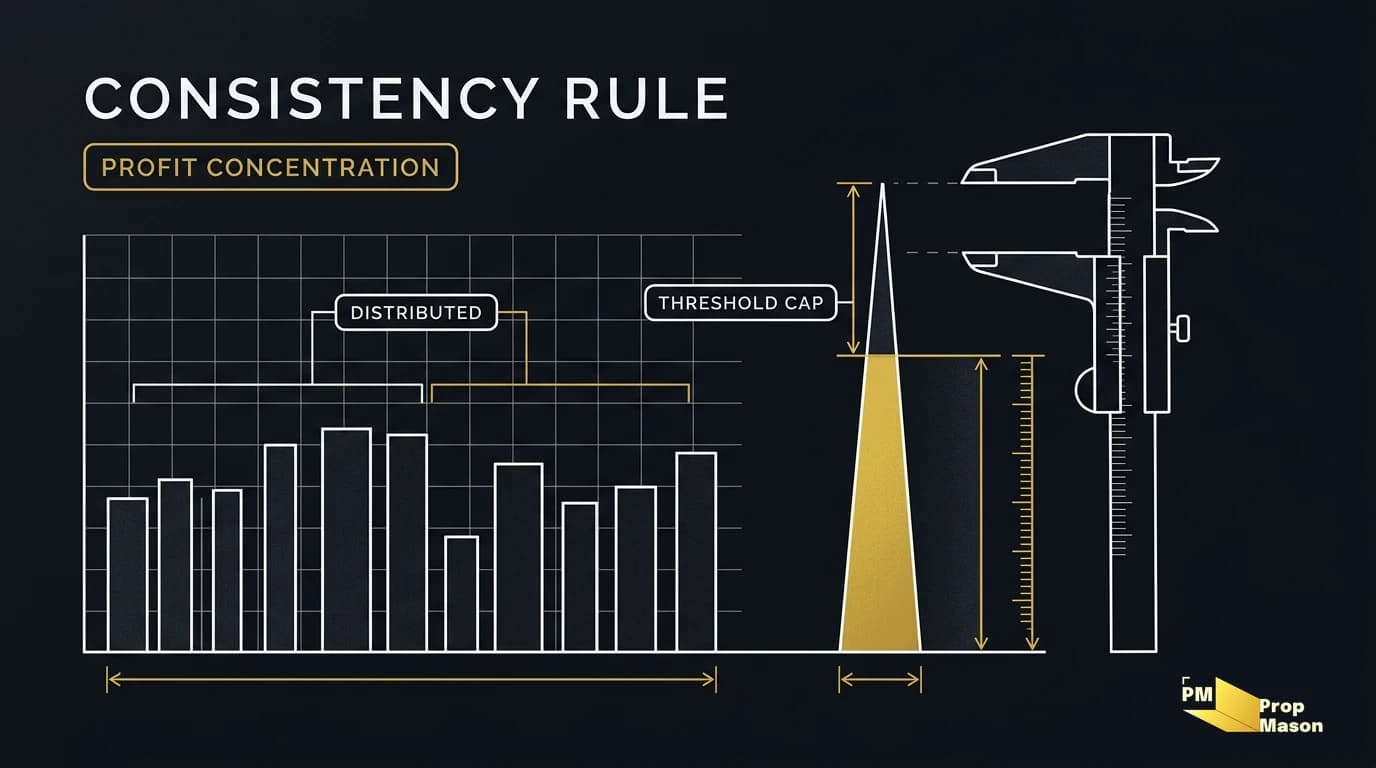
| Program | Account size | Published consistency cap |
|---|---|---|
| FTMO 1-Step | $50,000 | 50% |
| Take Profit Trader Trading Test | $50,000 | 50% |
| TradeDay Fast Pass, end of day | $50,000 | 45% |
| TradeDay Quick Pay, end of day | $50,000 | 30% |
| Bulenox Qualification, end of day | $50,000 | 40% |
| Instant Funding One-Phase | $50,000 | 40% |
Figures read: Topstep on 25 October 2026, FTMO on 23 October 2026, TradeDay on 25 October 2026.
Why "consistency rule" means different formulas by stage
Traders often treat every "consistency rule" label as the same math, only to discover at checkout or payout time that two firms measure completely different things. In evaluation challenges, a consistency rule usually sets a ceiling on how much of the fixed profit target you can earn in a single session; on funded accounts, the same phrase often turns into a dynamic ratio that divides your best winning day by your cumulative net profit inside a payout cycle.
Beyond profit concentration, some prop firms use the word "consistency" for lot-size bands, minimum active days or manual risk-desk reviews. Mixing those four rule classes leads to bad position sizing, so separate them before you place your first trade:
| Rule class | What the firm measures | Typical consequence when missed |
|---|---|---|
| Profit concentration | Best single day or trade divided by the profit target or total net profit | Raises the profit required to pass or delays payout eligibility until total profit grows |
| Position-size consistency | Whether contract or lot size stays within a set band around your average trade | Trades outside the band may be excluded from eligible profit during payout review |
| Activity requirement | Minimum trading days, qualifying sessions or minimum daily profit thresholds | Account stays open, but evaluation completion or withdrawal waits for more active days |
| Compliance review | Prohibited execution habits, all-or-nothing windfall bets or account rolling | Manual desk audit that can deny a payout request or close the account |
Always record the stage, numerator, denominator, session cutoff and reset rule from the firm's current help page rather than relying on a single percentage on a pricing card.
How the denominator changes the dollar math in a worked example
For any profit-concentration cap, write the fraction out in full before calculating your daily profit ceiling:
Consistency percentage = largest eligible winning day ÷ declared profit denominator × 100
To see how a stricter percentage changes your target in dollars, compare Take Profit Trader's 50K Trading Test ($3,000 profit target, 50% cap, minimum 3 trading days) and TradeDay's 50K Quick Pay evaluation ($3,000 target, 30% cap, minimum 5 trading days).
Suppose you book a $1,500 winning session during evaluation. On Take Profit Trader's $3,000 target, that single session equals the 50% ceiling, so you can pass as soon as your remaining sessions bring total net profit to $3,000 across at least 3 trading days.
TradeDay Quick Pay's 30% rule is tighter on the same $3,000 target. If the account closes out at that mark, the largest session it can contain is $900 . Keep the session from the example above and the ratio only comes back to 30% once cumulative net profit reaches $5,000 , because that session is 30% of that total.
How Topstep separates Trading Combine and XFA payout rules
Topstep illustrates why you must check the account stage before quoting a rule. On a 50K Trading Combine ($3,000 profit target and $2,000 maximum loss limit; a daily loss limit is optional at checkout), the evaluation consistency objective compares your best single trading day against the fixed profit target; if your best session exceeds that share, the profit required to pass rises until the ratio is satisfied.
Once you move to an Express Funded Account (XFA), where the minimum withdrawal is $125 at a 90% split, payout eligibility depends on which payout path your account uses. Topstep's payout policy page (checked 25 October 2026) states the two funded paths verbatim:
"Standard Path: 5 winning days of $150+; Request 50% of the account balance / up to $2,000; 90/10 split. Consistency Path: 3 days with 40% consistency target; Request 50% of the account balance / up to $3,000; 90/10 split. With a Daily Loss Limit added at Trading Combine checkout (limited time offering): Standard up to $4,000; Consistency up to $6,000. Note for traders who joined the new Topstep dashboard before January 12, 2026: You receive 100% of your first $10,000 in lifetime profits. After that, the 90/10 split applies. Payouts from the Legacy dashboard do not contribute to the first $10K."
The quote shows the XFA Consistency Path pairing a minimum number of trading days with a consistency target, while the Standard Path counts winning days of a set size and has no best-day percentage. Topstep's XFA parameters page defines the Consistency Path ratio as your largest winning day divided by total net profit, and the window resets after each approved payout. Per the same page, both paths also reset the account's Maximum Loss Limit after each payout.
How seven major prop firms apply consistency across stages
Prop firms differ on whether consistency applies during the evaluation, on the funded account, or in both stages. The table below compares current published terms across seven firms without ranking them:
| Firm | Evaluation stage rule | Funded stage rule | Consequence if best day exceeds the cap |
|---|---|---|---|
| Topstep (combine, payouts) | Best day measured against the Trading Combine profit target | Applies on the XFA Consistency Path (Largest Winning Day ÷ Total Net Profit); no cap on XFA Standard Path | Raises the profit needed to pass the Combine or holds XFA Consistency payout eligibility until the ratio is met |
| Take Profit Trader (Rule 5) | 50% cap with at least 3 trading days | None on funded PRO accounts (TPT announcement) | Does not fail the test; increases the total profit required to pass |
| Apex Trader Funding (terms, payout consistency) | No evaluation cap; can pass in 1 trading day | Best-day cap applies on funded PA accounts when requesting a payout | Delays payout approval until cumulative funded profit lowers the best-day ratio |
| FTMO (objectives) | 50% Best Day Rule on the 1-Step Challenge (FTMO calls it the Consistency rule for newer orders) | 50% Best Day Rule continues on 1-Step funded accounts | Not an account breach; trader continues trading until the largest day is at or below the cap |
| FundedNext (futures) | The futures page lists a consistency rule for the Flex challenge; its percentage is not in our data yet | None shown for funded Flex accounts on the futures page; check the model you plan to buy | The data behind this page does not give the outcome past the cap; read the firm's rules for your model |
| TradeDay (how it works) | 30% (5 days) on Quick Pay; 45% on Fast Pass | Set by its funded payout policy, which this page does not cover | Not a fail; the profit target rises until the best day is back under the cap (TradeDay help) |
| Earn2Trade (TCP, rules update) | Best-day consistency applies during the 50K Trader Career Path ($3,000 target) | No consistency requirement on funded LiveSim or live accounts | Must bring the best day inside the limit before graduating from the evaluation |
Keep the stage separate from the consequence when comparing offers. An evaluation cap that simply raises your profit target behaves like a soft gate, whereas a funded payout cap locks your withdrawal inside the account while you remain exposed to the firm's drawdown rules.
What to verify in the rulebook before buying a challenge
Before paying an evaluation fee, open the firm's help center and confirm the exact fraction used for your plan and payout path. Write down whether the numerator is gross or net of commissions, whether the denominator is the static profit target or current cumulative net profit, and how losing days affect the total. Some firms divide by total net profit after losses, while others, such as FTMO's older 1-Step Best Day Rule, compare your largest day against the sum of positive trading days, and FTMO's newer Consistency rule uses total profit.
Next, verify the daily session cutoff and time zone. On futures platforms such as Topstep, the trading day locks at a fixed Central Time hour that its payout policy page lists, so trades held or closed across the settlement bell can split or combine daily P&L in ways your charting clock might not show. Also check when the consistency window resets: on a funded account, a payout can reset the best-day counter for the next cycle, whereas an evaluation counter runs until you pass or reset the challenge.
Finally, confirm whether exceeding the percentage triggers a hard account fail, a manual compliance review, or a soft target adjustment, and bookmark the official rule URL alongside the date you checked the page so you can spot policy edits before your next withdrawal request.
When trading more days fixes your ratio and when it backfires
Whether adding more trading sessions can repair a skewed consistency ratio depends on the denominator in your contract and how close your balance sits to the drawdown floor.
If your program uses cumulative net profit as the denominator (such as Take Profit Trader at 50% or TradeDay Fast Pass at 45%), booking smaller positive days expands the denominator and pulls your best-day share down without requiring a reset. The key is sizing down once you hit a large winning day so you add steady net profit without giving back the cushion you already banked.
Adding more days does not work when a red day shrinks your net-profit denominator and pushes your best-day percentage even higher, or when the rule you broke is a hard position-size limit or prohibited-conduct clause. If a single windfall day leaves you needing thousands of dollars in extra profit while a trailing drawdown sits right underneath your equity, forcing extra trades often breaches the loss limit before the consistency math catches up.
Related Reading
Sources and methodology
We checked the consistency formulas, evaluation rules and payout-path conditions on each firm's official documentation on the dates shown in the key-facts table above; see our methodology for how PropMason verifies prop firm rules:
- Topstep Payout Policy, checked 25 October 2026.
- Consistency at Topstep, checked 25 October 2026.
- Topstep Trading Combine Parameters and Express Funded Account Parameters, the stage definitions behind the Topstep rows above.
This article is educational and does not provide financial, investment, legal or tax advice. PropMason may receive commissions from links on this page; see the affiliate policy. Commercial relationships do not change the order of firms or what we write about them. Trading futures and forex carries a risk of loss. The CFTC and the NFA publish warnings and fraud advice for traders in the United States. Read how PropMason checks and edits its pages in the editorial policy.
FAQ
How is a prop firm consistency rule calculated?
Most profit-concentration rules divide your largest winning trading day by either the evaluation profit target or your current cumulative net profit to express the ratio as a percentage. Always check whether the firm uses net profit after losses or the sum of positive days as the denominator.
Does Topstep have a consistency rule, and is it the same on the Trading Combine and XFA?
No. On the Trading Combine, the best-day target is measured against the evaluation profit target. On an Express Funded Account (XFA), consistency applies only if you are on the XFA Consistency payout path, where your largest winning day is divided by total net profit across the payout cycle.
Can trading more days lower my consistency percentage?
Yes, provided your program divides by cumulative net profit and allows you to keep trading past the base target. Earning additional net profit on new days increases the denominator and lowers the percentage, whereas a losing day shrinks net profit and raises the ratio.
Does breaking a consistency rule fail my account?
At Topstep, FTMO and Take Profit Trader, going past the best-day cap does not close the account. Instead, it raises the total profit required to pass the challenge or pauses payout eligibility until additional profit brings the ratio back under the cap.
Is best-day consistency the same as lot-size consistency?
No. Best-day consistency is a mathematical cap on how much of your total dollar profit came from your top session. Lot-size consistency checks whether your position sizes stay inside a normal range around your average trade size during compliance review.
Does FTMO have a consistency rule?
Yes, on the 1-Step Challenge. FTMO publishes a 50% Best Day Rule there, and it continues on 1-Step funded accounts. Going past it is not an account breach; you keep trading until your largest day is at or below the cap.
Is there a prop firm with no consistency rule?
Not as a blanket category, because most firms apply the rule at one stage and drop it at another. Take Profit Trader lists no cap on funded PRO accounts, Earn2Trade none on funded accounts and Apex none during evaluation, yet each applies a rule somewhere else. A name that suggests freedom is no guarantee: Instant Funding lists 40% on its One-Phase program and 15% on IF Micro Lite. Check the program you plan to buy.
Next step
Before paying for a challenge, find the consistency rule on the program's own rule page (Topstep keeps it in its Consistency at Topstep article), multiply the best-day cap by the profit target to see the largest single day you can book if you finish exactly on target, and set a daily profit stop just below that dollar figure on your trading platform.