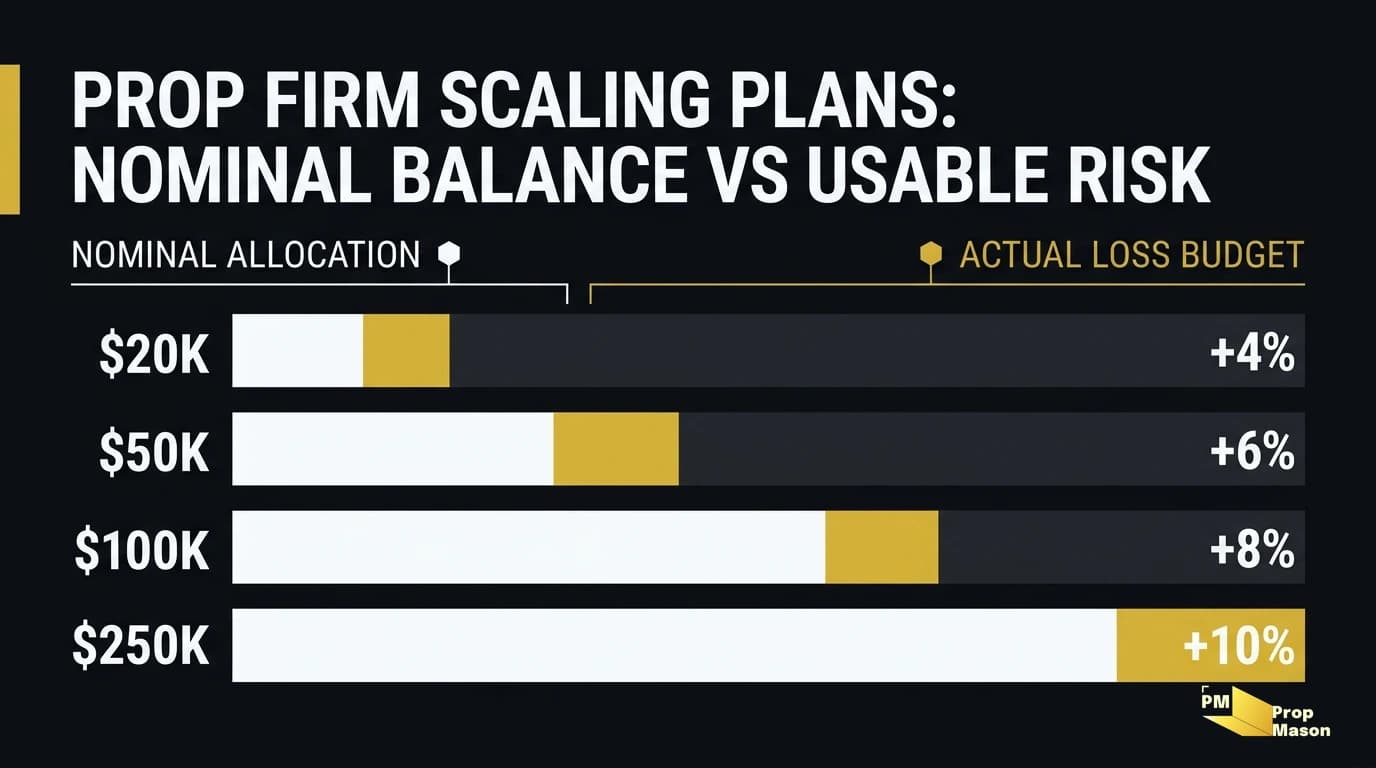
| Firm and program | Account size | Profit target | Daily loss | Maximum loss | Profit split |
|---|---|---|---|---|---|
| Topstep Standard Path | 100K | $6,000 | Optional, chosen at checkout | $3,000 | 90% |
| FTMO 2-Step Standard | 100K | 10% | 5% | 10% | 80% |
| The5ers Bootcamp | 20K | 6% | 3% | 5% | see The5ers |
| Earn2Trade Trader Career Path | 50K | $3,000 | $1,100 | $2,000 | 50% to 80% |
Nominal balance versus usable loss budget
A scaling plan changes one or more account terms after you meet stated milestones, but a larger nominal balance does not automatically give you the same jump in usable risk. On a $20,000 The5ers Bootcamp step, a 5% maximum loss cap leaves $1,000 of loss room against a $1,200 (6%) profit target.
On an FTMO 2-Step Standard $100,000 account, the 10% static maximum loss equals $10,000 of total room alongside a 5% daily loss limit. At Topstep, a 100K Standard Path account pairs a $3,000 trailing loss limit with a $6,000 evaluation target, and its funded scaling plan adjusts the maximum number of futures contracts you may hold as your account balance grows rather than issuing a larger nominal starting balance.
Size and loss room are separate numbers. Because of that, two traders looking at the same headline allocation can face very different position-sizing limits. In every comparison, calculate the dollar loss allowance from the firm's drawdown formula and note whether that floor is static, end-of-day trailing or locked at starting capital.
How Topstep, The5ers and FTMO structure their scaling paths
Each firm scales a different part of the contract: Earn2Trade ties a larger account to withdrawing each step's profit target, Topstep expands your permitted futures contract size as your account balance grows, The5ers Bootcamp moves you up a step-by-step balance ladder each time you hit a stage target, and FTMO increases simulated balance and reward share once recurring performance requirements are met. None of these tables is a ranking of the best prop firms.
| Program and scaling page | Starting baseline in our data | How the scaling path works | Risk and split terms | Where to read the current ladder |
|---|---|---|---|---|
| Topstep Scaling Plan | Standard Path 100K combine with $3,000 EOD trailing loss limit | Limits how many lots or contracts an Express Funded Account may have open at once; permitted contract capacity steps up as your account balance grows | 90% trader split on Standard Path; the daily loss limit is an optional add-on | Read the contract-limit ladder on Topstep's Scaling Plan help page |
| The5ers Bootcamp | Bootcamp starts at a 20K evaluation step ($22 entry fee) and also offers a 250K tier | Account balance steps up each time you hit the stage profit target across 3 evaluation phases and subsequent funded milestones; The5ers' High Stakes page describes a separate ladder where balance and profit split rise each time a funded profit target is met | Each step carries a 5% max loss and 6% target on the 20K tier | Read the full balance steps and funded split tiers on the Bootcamp program page, checked 22 October 2026 |
| FTMO Scaling Plan | 2-Step Standard 100K simulated account | Traders who meet FTMO's recurring profit and time criteria over a multi-month review cycle qualify for a balance increase and a higher split | Base split starts at 80%, with 5% daily loss and 10% static max loss | Read the cycle length, net-profit threshold and cap on FTMO's scaling page |
| Earn2Trade Trader Career Path | Trader Career Path 50K tier, EOD drawdown in the evaluation | The firm says its growth plan unlocks a larger account when you withdraw the profit target at each step, and a progression ladder caps how many contracts you may hold | $2,000 max loss and $1,100 daily loss on this tier; split 50% to 80% | Read the tiers and contract caps on Earn2Trade's Trader Career Path page, checked 25 October 2026 |
We checked these program baselines on 23 October 2026. Because individual ladder increments, review intervals and maximum allocation caps sit outside our canonical fact pack, read the exact step table on each firm's linked scaling page before you pay.
Five rule groups that separate real risk room from a headline
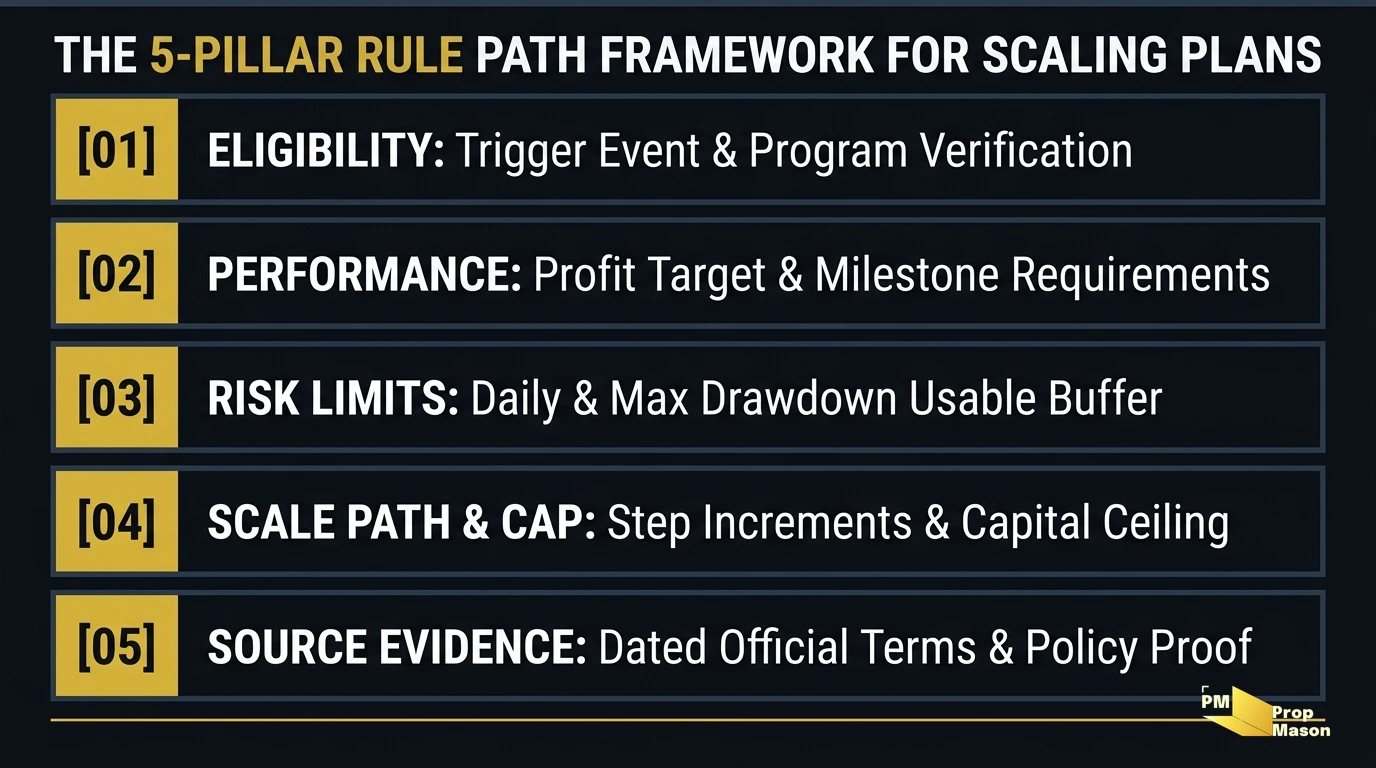
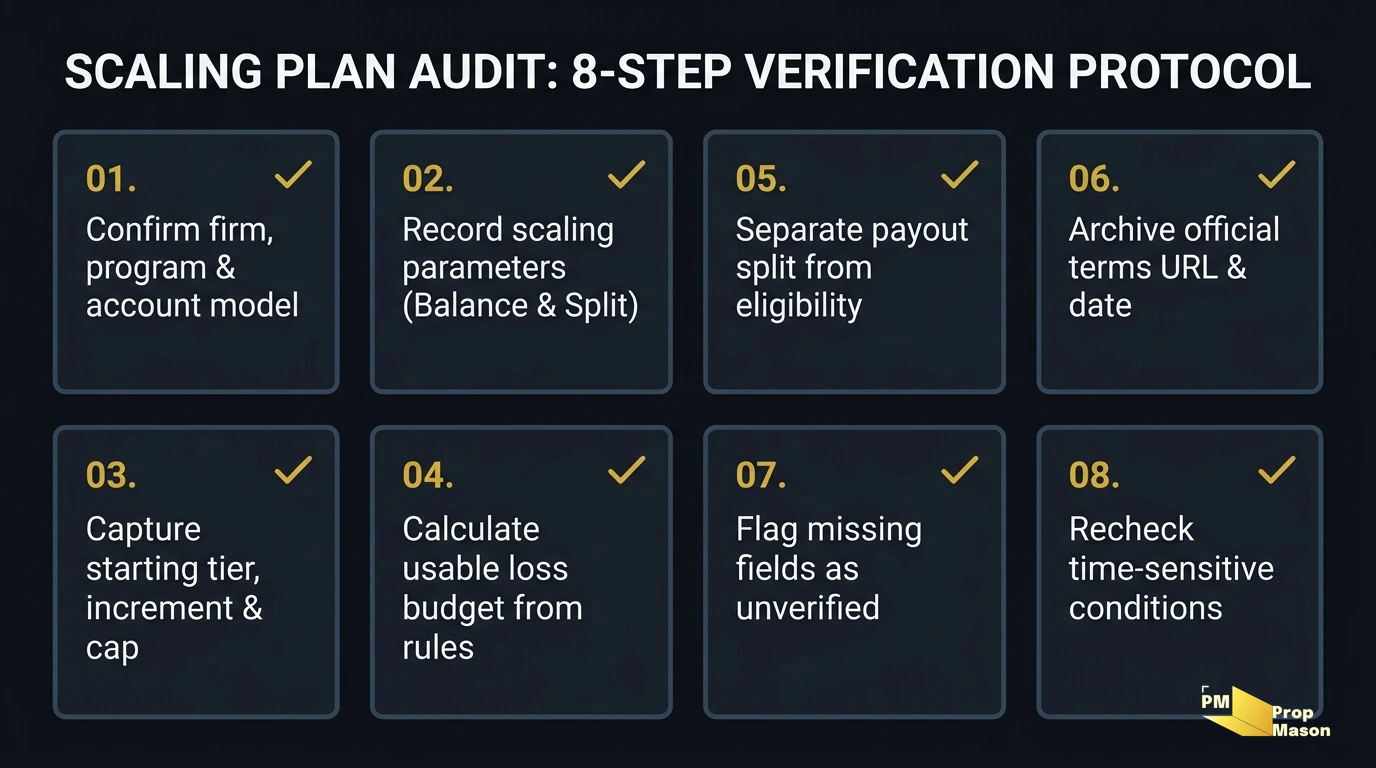
Evaluating a scaling plan requires checking five distinct rule groups rather than trusting a maximum-allocation banner on a sales page. If any group is missing from the firm's rulebook, you cannot calculate how much risk each step adds.
| Rule group | What to verify on the firm's page | What goes wrong if you skip it |
|---|---|---|
| Eligibility trigger | Whether scaling depends on a flat profit target, a multi-month cycle, consecutive profitable months or end-of-day equity | You can hit the profit figure early and still wait weeks for a calendar review window to close |
| What changes at each step | Whether the step raises simulated balance, usable dollar drawdown, contract limits or only the profit split | You size up assuming a wider loss buffer when only the nominal balance or contract cap moved |
| Drawdown baseline after scaling | Whether the new maximum loss is calculated from the original balance or the scaled balance, and whether the floor locks | A withdrawal or scale step can leave your loss floor narrower than the new headline balance suggests |
| Payout and split separation | Whether taking a payout resets the scaling clock or reduces the buffer needed to trade the higher contract tier | A withdrawal lowers your balance and can pull you under the level the next contract tier needs |
| Dated official documentation | The exact help-center URL and the date you read the ladder for your specific program variant | Relying on forum summaries or another program's card applies the wrong rules to your account |
The image above reduces to what you write down before paying: the exact firm, program and account model, what scales, the starting value, each increment, how often it can change and where it stops, the usable loss room from the daily and total loss rules, and the official URL with the date you read it. Treat any field the page does not state as unknown instead of filling it from another program.
How withdrawals and rule updates affect your scaling progress
Taking a payout or trading through a rule update can stall or reverse a scaling step if the program ties your position limit to current account equity. At Topstep, contract capacity on an Express Funded Account follows your current account balance, so a payout that lowers the balance can lower the contract limit.
Program rules, target percentages, contract ladders and eligibility windows also change over time. What we read on 23 October 2026 reflects each firm's published pages on that day, not a permanent guarantee. The date matters. Whenever a help article leaves out whether a withdrawal resets the review counter, ask customer support in writing before buying the evaluation.
Turning a scale step into a position-sizing decision
Whether a scaling plan improves your trading depends on whether your strategy is constrained by contract caps, dollar drawdown room or payout split. Before increasing your trade size after a scale event, compute three numbers from the firm's ladder: the change in nominal balance, the dollar change in maximum loss allowance, and the ratio of maximum loss to nominal balance before and after the step.
| Evaluation result | When this applies | How to act on it |
|---|---|---|
| Comparable scale step | The firm's scaling page states the trigger, before-and-after loss room, drawdown formula, review cadence and split | Adjust your position size in proportion to the new usable dollar loss room, never the nominal balance alone |
| Headline only | The sales page advertises a multi-million cap or higher split without publishing the step targets, drawdown reset rules or time intervals | Size your trades for the starting account parameters and treat future scaling as an unverified bonus |
| Do not rely yet | The help article contradicts the pricing card, lacks a clear formula, or belongs to a retired program tier | Hold off on the entry fee until the firm publishes one current table that matches its pricing card |
Worked application: on the starting $20,000 The5ers Bootcamp step, a 5% maximum drawdown gives you $1,000 of usable loss room to reach a $1,200 target, whereas FTMO's $100,000 2-Step Standard account provides $10,000 of static loss room from day one. If your strategy needs $10,000 of drawdown room immediately, starting on a smaller step-scaling ladder means trading with a $1,000 loss budget until you clear multiple targets. Match the starting loss budget to your normal losing streak first, and treat later scale steps as an expansion only after you read the firm's current ladder.
Related Reading
These four pages cover what decides whether a scale step is worth taking: the firm directory, how drawdown is measured, entry costs and payout rules.
- Prop firm directory
- Trailing vs EOD vs static drawdown
- Prop firm fees comparison
- Prop firm payout rules
Sources and methodology
We compared the program rules and scaling documentation published by each firm on the dates below; see our scoring methodology for how PropMason evaluates prop firms:
- Topstep Scaling Plan documentation and Standard Path parameters, checked 25 October 2026.
- The5ers Bootcamp official program page, checked 22 October 2026.
- FTMO Scaling Plan and FTMO pricing and objectives, checked 23 October 2026.
This content is educational, not financial, investment, legal or tax advice. PropMason may earn commissions from some links; see the affiliate policy. Commercial relationships do not change the order of firms or the wording about them on this page. Trading futures and forex carries a risk of loss. The CFTC and the NFA publish warnings and fraud advice for traders in the United States. Read how PropMason checks and edits its pages in the editorial policy.
FAQ
What does a prop firm scaling plan change?
Depending on the firm, a scaling plan can raise your simulated account balance, expand your maximum contract limit, widen your dollar loss allowance or increase your profit split. Topstep's scaling plan sets contract limits on Express Funded Accounts, while FTMO and The5ers adjust account balances and reward splits after you hit specific profit targets.
Is a larger scaled account always more usable risk?
No. Your true risk capacity equals the dollar distance between current equity and the breach floor, not the nominal account size. If a firm scales your nominal balance while locking the drawdown floor or keeping a tight 3% daily loss limit, your usable risk per trade grows only by the actual dollar increase in that loss buffer.
How do The5ers Bootcamp and FTMO differ in their starting numbers?
The5ers Bootcamp starts traders on a 20K evaluation step with $1,000 of maximum loss room and scales the balance at each stage milestone. FTMO's 2-Step Standard 100K challenge starts with a profit split of 80% and reviews funded accounts for balance and split increases over multi-month cycles.
Do withdrawals reset or slow down a scaling plan?
It depends on the program. Pulling profits out of a futures account whose contract cap follows its balance can lower that cap. Read the payout page and the scaling page of the exact program together before requesting a withdrawal.
Which prop firms offer the best scaling options?
No single scaling plan fits every trading style; see how PropMason orders firms. Futures traders who want clear contract-size tiers from day one look at Topstep, low-entry step-ladder traders look at The5ers Bootcamp, and traders who prefer a larger initial balance with periodic split upgrades look at FTMO. Futures traders who want a step-by-step growth plan with a contract ladder can also read Earn2Trade, whose Trader Career Path ties each larger account to withdrawing the profit target.
How do the Topstep scaling rules work on an Express Funded Account?
The contract cap on a Topstep Express Funded Account (the funded stage, often shortened to XFA) follows your current account balance: as the balance grows, the number of contracts you may hold at once steps up. The step table differs by account size, so read the ladder for your own tier on Topstep's Scaling Plan help page before you size a trade. A payout that lowers the balance can lower the cap.
How does the FTMO scaling plan work and how large can an account get?
FTMO says traders who meet its recurring profit and time criteria over a review cycle can qualify for a larger simulated balance and a higher profit split than the base 80% on the 2-Step Standard account. The cycle length, the net-profit threshold and the maximum allocation are listed on FTMO's scaling page; they are not in our fact pack, so read them there and note the date.
How does The5ers scaling work?
The5ers uses different ladders by program. Bootcamp raises the balance as you hit each stage target, and the firm's High Stakes page describes funded accounts that grow in steps, with the profit split rising along the way. The step table sits on each program page, so match the table to the exact program you buy.
Next step
Open the official scaling page for the exact program you plan to buy and write down the starting dollar loss limit alongside the first scale trigger. Size your trades for the day-one loss budget first, and verify whether taking a payout reduces your contract cap or resets the review timer before you pay the registration fee.