| Program | Account size | Profit split | Minimum payout |
|---|---|---|---|
| FTMO 1-Step | $100,000 | 90% | $20 |
| FTMO 2-Step Standard | $100,000 | 80% | $20 |
| TradeDay Fast Pass, end of day | $50,000 | 80% | $250 |
| Earn2Trade Gauntlet Mini | $50,000 | 50% to 80% | $100 |
| The5ers High Stakes | $100,000 | 80% to 100% | $500 |
| Bulenox Momentum, end of day | $100,000 | 90% | $1,000 |
Figures read: FTMO on 23 October 2026, TradeDay on 25 October 2026, Earn2Trade on 25 October 2026, The5ers on 22 October 2026, Bulenox on 25 October 2026.
What a 90% versus 80% split means in dollars
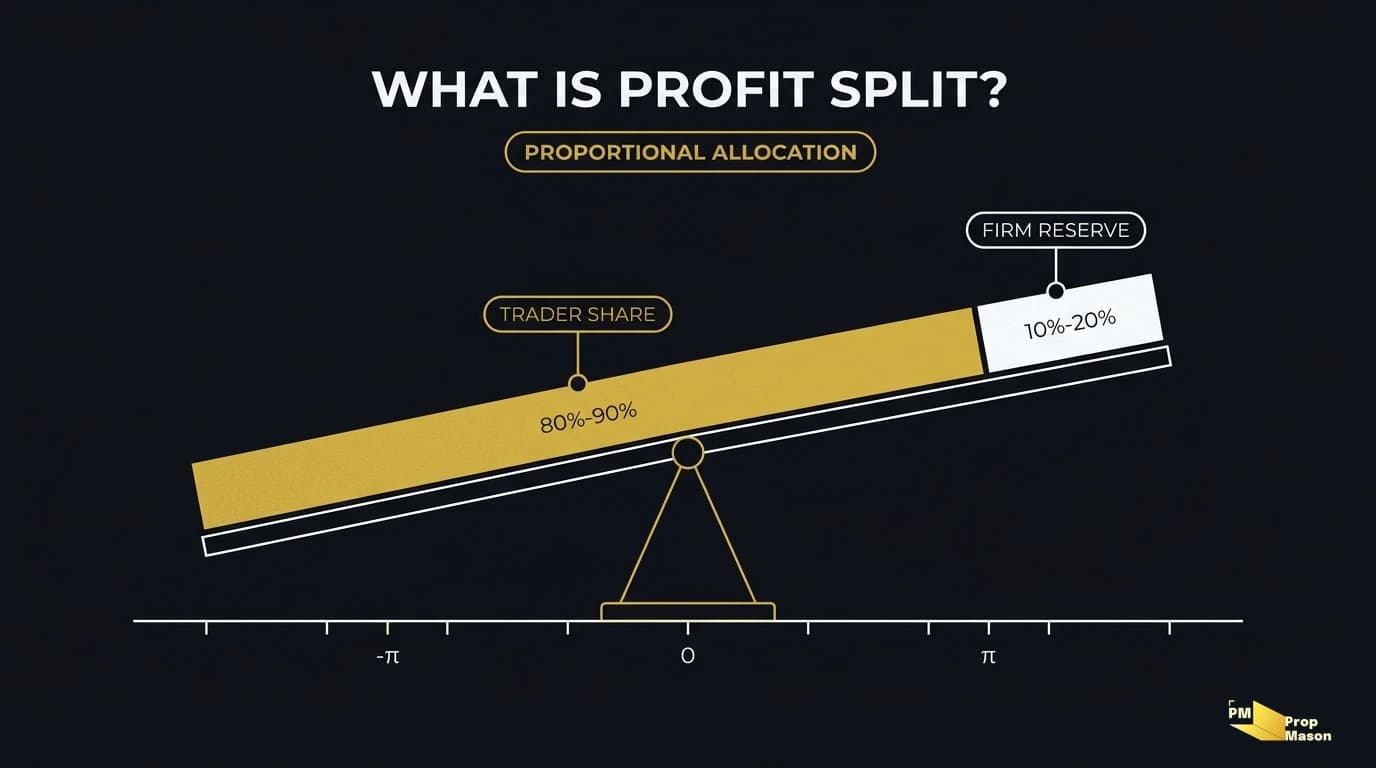
A profit split is the contractual percentage of approved eligible profit that a prop firm pays to the trader on a funded account. The percentage applies only to net profit that clears the firm's compliance and buffer rules, never to the nominal starting balance. It is not a fee for providing capital. An advertised split also says nothing about whether a request gets approved.
To see what the rate gap is worth in cash, suppose a 50K account holds $3,000 of approved profit, the same size as TradeDay's profit target on that account. At FTMO 1-Step's 90%, that pays $2,700 before transfer charges; at TradeDay Fast Pass's 80%, it pays $2,400, a $300 difference. A per-cycle cap sits on top of the split: TradeDay Fast Pass limits one cycle to $1,500, so the cap, not the percentage, sets how much leaves in a single request.
Flat splits versus tiered splits at FTMO, TradeDay and Earn2Trade
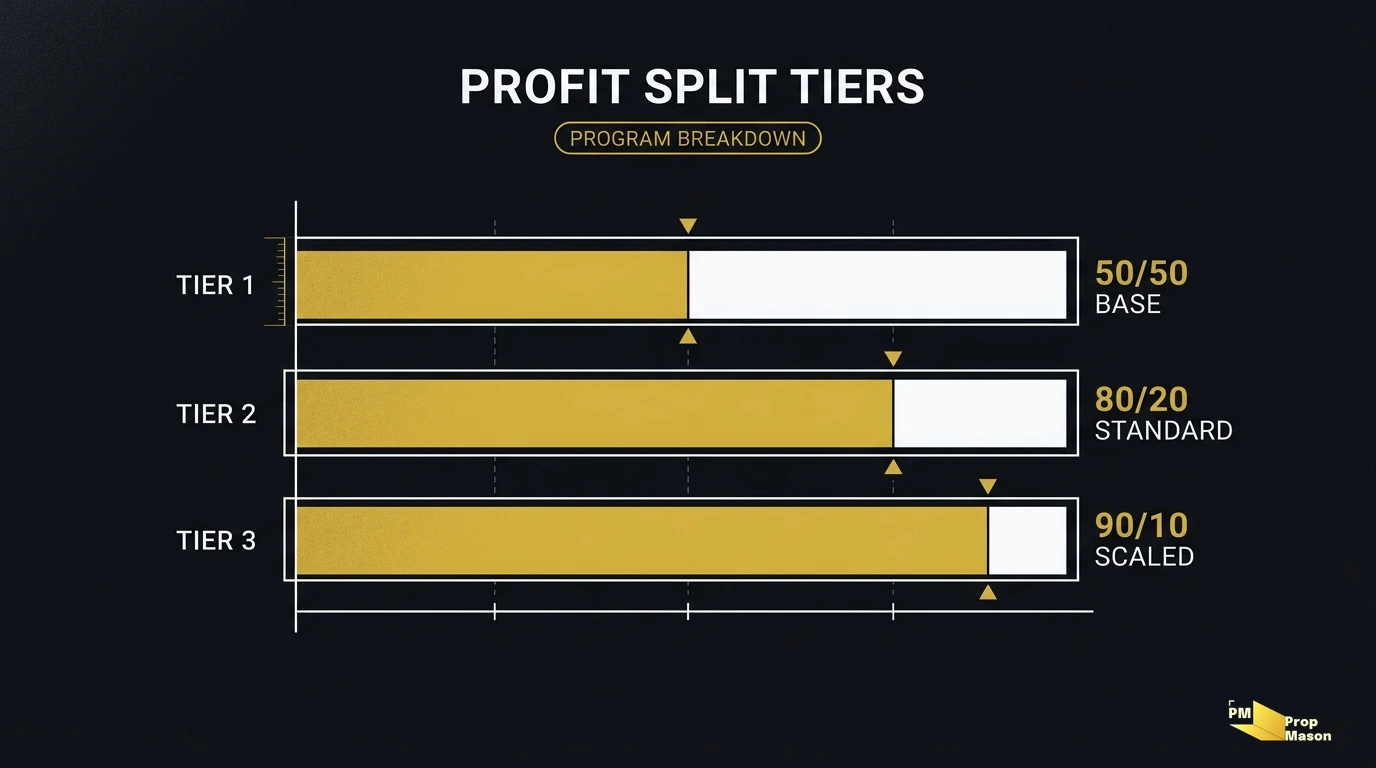
Prop firms apply profit splits in three main ways: a flat rate from the first withdrawal, a base rate that increases only after you meet scaling conditions, or a tiered rate that starts lower and steps up once your profit or withdrawal amount passes a threshold. The table below compares published terms from each firm's pages without ranking them. Three firms are not a market-wide range, and the rows are not proof that the programs are equivalent.
| Firm or program | Published split structure | Official source page | What to check before relying on the headline |
|---|---|---|---|
| FTMO | 1-Step pays 90%; 2-Step pays 80% and rises when Scaling Plan or Premium Programme criteria are met | FTMO reward FAQ and comparison table | Rewards come from simulated trading; keep the 1-Step and 2-Step starting rates separate |
| TradeDay | Fast Pass Funded Sim pays 80%; Quick Pay Funded Sim changes the split by the profit sitting in the account | TradeDay pricing page, Quick Pay payout policy and TradeDay 2.0 notice | Tiered plans pay a lower share on early profits before stepping up; check the current payout page for the threshold on your plan |
| Earn2Trade | Funded accounts from $25,000 to $200,000 use a tiered 50% to 80% split set by the size of each withdrawal | Earn2Trade profit-split rule update, TCP and Gauntlet Mini pages | The lower rate applies to a withdrawal below the firm's threshold for your account size and the higher rate to one at or above it; read the exact tier table on your program card |
Because tiered thresholds at TradeDay and Earn2Trade depend on the exact plan and purchase date, open each firm's linked payout page to see the dollar mark where the higher split kicks in.
Where the profit split sits inside the payout approval flow
The split is the final multiplier at the end of a multi-stage approval chain, not the first rule that triggers when your account turns green. Evaluation challenges, instant-funding accounts and simulated live stages such as Earn2Trade's LiveSim each define eligible profit differently; see our evaluation stages guide and prop firm payout rules for the full sequence.
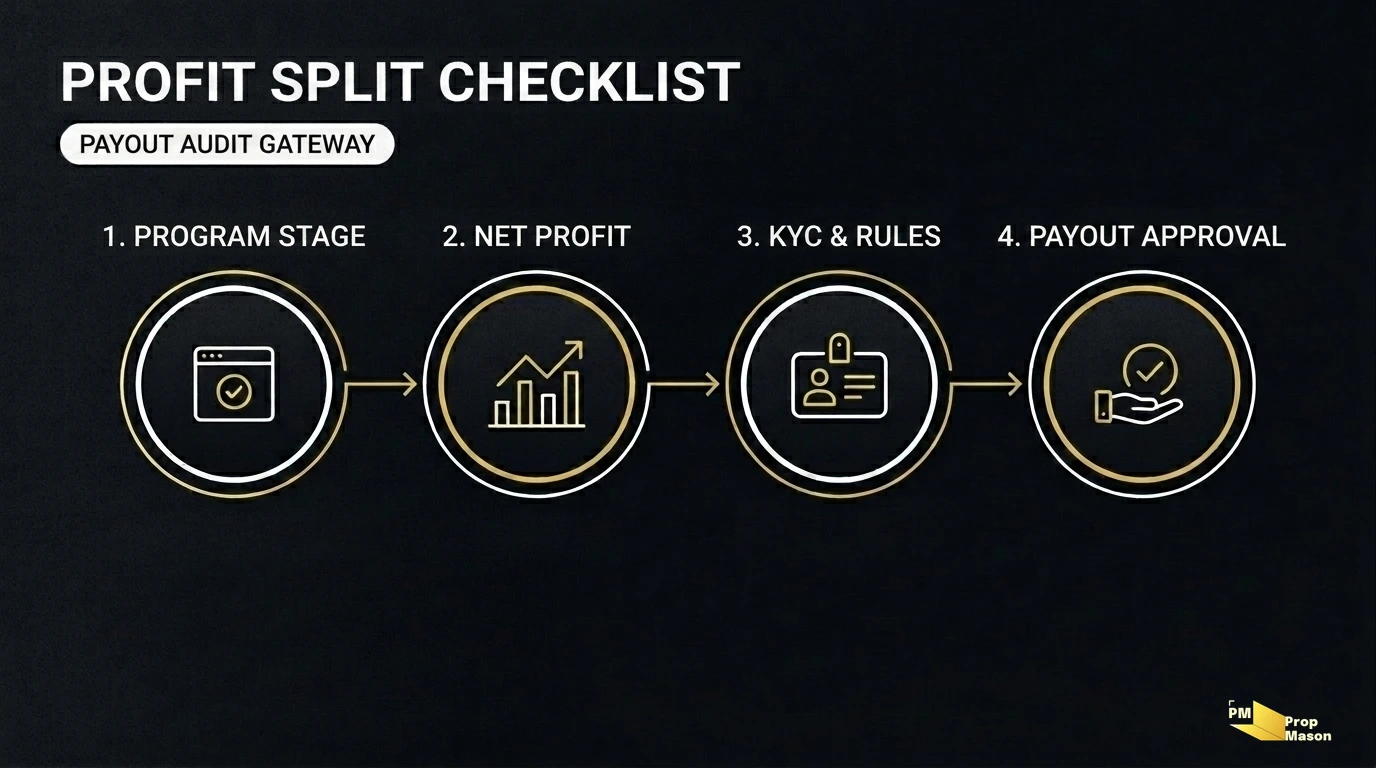
| Payout gate | What to check on the firm's payout page | What happens if you overlook it |
|---|---|---|
| Account stage and buffer | Whether the split applies to a simulated funded stage, LiveSim or live brokerage account, and whether a drawdown buffer must stay in the account | Profits inside the required safety buffer cannot be withdrawn, reducing the eligible dollar amount before the split is applied |
| Minimum withdrawal threshold | The smallest request the firm accepts: $20 at FTMO, $100 at Earn2Trade, or $250 at TradeDay | Small early gains sit locked in the account until closed net profit clears the firm's minimum bar |
| Per-cycle withdrawal cap | Whether the plan limits how much you can pull per request, such as $1,500 on TradeDay Fast Pass 50K | Even a large winning month leaves the balance above the cap in the account, exposed to trading risk until a later cycle |
| Trading conduct and consistency | Whether a best-day rule, minimum trading days or prohibited strategy review applies during the payout window | A compliance or consistency breach delays or voids the withdrawal regardless of the advertised split percentage |
| KYC, tax forms and payout rails | Identity verification timing, W-9 or W-8BEN tax forms, wire fees and whether the payout processor serves your country | An unsupported bank or unverified identity blocks the transfer after your trading meets every rule |
Common mistakes when comparing advertised split percentages
The most expensive mistake is picking a challenge for its banner percentage while ignoring how the firm calculates trailing, EOD or static drawdown. A tight trailing limit that closes your account during a normal pullback makes a high split irrelevant, because you only collect a share of profits on accounts that survive to the payout window.
Traders also misread tiered and scaled ranges as flat rates. When a program lists 50% to 80%, the lower figure applies to any withdrawal below the firm's threshold for your account size. Treating the top of the range as your day-one take-home rate overstates what your first withdrawal will bring back. The banner shows the best case.
A third error is relying on old payout screenshots or forum summaries. Firms revise their split tiers, buffer rules and payment providers through rule updates, as Earn2Trade did with its profit-split rule update and TradeDay did with TradeDay 2.0. Whenever a sales page advertises a split without linking the current rulebook, treat the payout terms as incomplete until you read the help center directly.
When a lower flat split beats a higher advertised maximum
Choosing between a flat 80% split, a tiered 50% to 80% structure and a 90% split depends on how often you plan to withdraw and how large your typical payout is. Your withdrawal habit decides which rate wins. The highest number on a pricing card rarely tells you that.
If you withdraw smaller profits as soon as you clear the $20, $100 or $250 minimum, a flat rate that starts at 80% or 90% on payout one delivers more cash early on than a tiered schedule whose lower rate applies to small requests in a 50% to 80% band. A trader whose withdrawals stay small may never reach the upper tier.
If you hold a larger account such as TradeDay's 100K Fast Pass (80% split) and aim for multi-thousand-dollar payouts, the per-cycle withdrawal cap of $1,875 matters more than a small difference in the split percentage. Compare the payout methods and thresholds alongside the entry fee on a 100K FTMO account (€499 on 1-Step, which FTMO lists as non-refundable, versus €540 on 2-Step, which is refunded with the first payout) to see which contract leaves more money in your bank account.
The same test works on the two extra rows in the key-facts table. Bulenox lists a flat 90% on its 100K Momentum account but a $1,000 payout minimum, so a small early profit waits longer there than at a firm with a lower minimum. The5ers publishes a split range of 80% to 100% on its 100K High Stakes program with a $500 minimum and a $4,000 per-cycle cap.
Related Reading
- Prop firm payout rules
- How prop firm evaluations work
- Trailing vs EOD vs static drawdown
- Instant funding vs challenge accounts
Sources and methodology
We pulled the profit-split percentages, minimum withdrawal amounts and policy notes from each firm's public pages on the dates printed under the key-facts table; see our methodology for how PropMason compares firm rules:
- FTMO reward withdrawal FAQ and FTMO comparison table, checked 23 October 2026.
- TradeDay pricing and rules and TradeDay 2.0 announcement, checked 25 October 2026.
- Bulenox accounts and pricing and The5ers High Stakes, checked 25 October 2026 and 22 October 2026.
- Earn2Trade profit-split rule update, Trader Career Path and Gauntlet Mini, checked 25 October 2026.
This article is educational, not financial, investment, legal or tax advice. PropMason may earn commissions from some links; see the affiliate policy. Commercial relationships do not change the order of firms or the wording about them on this page. Trading futures and forex carries a risk of loss. The CFTC and the NFA publish warnings and fraud advice for traders in the United States. Read how PropMason checks and edits its pages in the editorial policy.
FAQ
What is profit split in a prop firm?
It is the contractual share of approved net profit that the firm pays out to a funded trader, while the firm retains the remainder. Depending on the program, the rate can be a flat 90% as on FTMO 1-Step, a base 80% that rises with scaling as on FTMO 2-Step, or a tiered 50% to 80% range as on Earn2Trade.
Does a higher profit split always mean a better payout?
No. A higher percentage produces less cash in hand if the program pairs it with a tight per-cycle withdrawal cap like $1,500, a large mandatory safety buffer, or a trailing drawdown that closes the account early. You must multiply the split by the actual profit you can withdraw under the program's rules.
What is the FTMO profit split?
FTMO 1-Step lists 90% and 2-Step lists 80%, with 2-Step rising when the Scaling Plan or Premium Programme criteria are met. The rate depends on the program, so match it to the account you plan to buy, and read FTMO's reward FAQ for the current terms.
What is The5ers profit split?
The5ers lists 80% to 100% on its 100K High Stakes program, with a $500 minimum payout and a $4,000 cap per cycle. The pack does not hold the point where the rate moves inside that range, so check The5ers' own page before you plan a first payout.
Is profit split the same as take-home profit?
No. Your take-home payout equals approved eligible profit multiplied by your split percentage, minus any wire, ACH, intermediary bank or currency-conversion charges, and capped by the program's per-cycle withdrawal limit. Taxes also apply based on your jurisdiction and tax status.
Why do some prop firms show a range like 50% to 80% instead of one number?
A range means the split is tiered or stage-dependent. At Earn2Trade, the rate depends on the size of each withdrawal: a request below the dollar threshold for the account size is paid at the lower end of 50% to 80%, and one at or above it at the top of the range.
Next step
Open the payout policy page for each program on your shortlist and write down five numbers side by side: the starting split on your first withdrawal, the dollar threshold where any higher tier begins, the minimum payout, the per-cycle withdrawal cap, and the required drawdown buffer. Calculate what your first realistic withdrawal would pay after those rules before buying an evaluation.